
Textbook Question
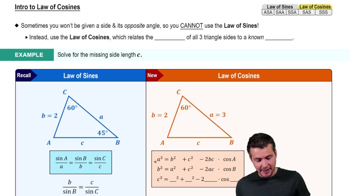
The bearing of a lighthouse from a ship was found to be N 37° E. After the ship sailed 2.5 mi due south, the new bearing was N 25° E. Find the distance between the ship and the lighthouse at each location.
1450
views

 Verified step by step guidance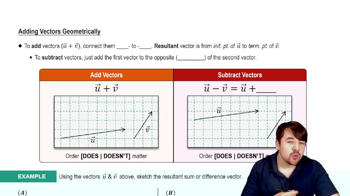
 05:29
05:29
 4:35
4:35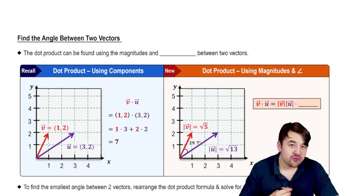 04:33
04:33The bearing of a lighthouse from a ship was found to be N 37° E. After the ship sailed 2.5 mi due south, the new bearing was N 25° E. Find the distance between the ship and the lighthouse at each location.
Given u = 〈-2, 5〉 and v = 〈4, 3〉, find each of the following.
-5v
A force of 25 lb is required to hold an 80-lb crate on a hill. What angle does the hill make with the horizontal?
Radio direction finders are placed at points A and B, which are 3.46 mi apart on an east-west line, with A west of B. From A the bearing of a certain radio transmitter is 47.7°, and from B the bearing is 302.5°. Find the distance of the transmitter from A.
Standing on one bank of a river flowing north, Mark notices a tree on the opposite bank at a bearing of 115.45°. Lisa is on the same bank as Mark, but 428.3 m away. She notices that the bearing of the tree is 45.47°. The two banks are parallel. What is the distance across the river?
A force of 176 lb makes an angle of 78° 50′ with a second force. The resultant of the two forces makes an angle of 41° 10′ with the first force. Find the magnitudes of the second force and of the resultant.
<IMAGE>