Solve each equation over the interval [0°, 360°). Write solutions as exact values or to the nearest tenth, as appropriate. 2sin θ ―1 = csc θ
Verified step by step guidance
1
Rewrite the given equation \(2\sin \theta - 1 = \csc \theta\) by expressing \(\csc \theta\) in terms of \(\sin \theta\). Recall that \(\csc \theta = \frac{1}{\sin \theta}\), so the equation becomes \(2\sin \theta - 1 = \frac{1}{\sin \theta}\).
Multiply both sides of the equation by \(\sin \theta\) to eliminate the fraction, keeping in mind that \(\sin \theta \neq 0\) to avoid division by zero. This gives \(2\sin^2 \theta - \sin \theta = 1\).
Rearrange the equation to standard quadratic form in terms of \(\sin \theta\): \(2\sin^2 \theta - \sin \theta - 1 = 0\).
Use the quadratic formula to solve for \(\sin \theta\). Recall the quadratic formula is \(x = \frac{-b \pm \sqrt{b^2 - 4ac}}{2a}\), where \(a=2\), \(b=-1\), and \(c=-1\). Substitute these values to find the possible values of \(\sin \theta\).
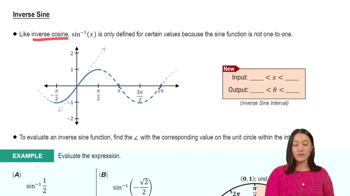
For each solution of \(\sin \theta\), determine the corresponding angles \(\theta\) in the interval \([0^\circ, 360^\circ)\) by using the inverse sine function and considering the sine function's positive and negative values in different quadrants.
Verified video answer for a similar problem:
This video solution was recommended by our tutors as helpful for the problem above
Play a video:
0 Comments
Key Concepts
Here are the essential concepts you must grasp in order to answer the question correctly.
Trigonometric Functions and Their Relationships
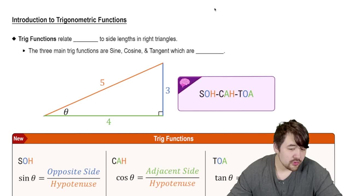
Understanding sine (sin) and cosecant (csc) functions is essential, as csc θ is the reciprocal of sin θ. This relationship allows rewriting the equation in terms of a single function, simplifying the solving process.
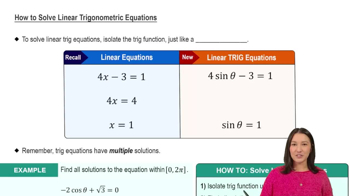
Solving equations like 2sin θ - 1 = csc θ involves algebraic manipulation and applying identities. After rewriting, isolate the trigonometric function and find all solutions within the given interval, considering the domain restrictions.
The problem restricts θ to [0°, 360°), so solutions must be found within one full rotation of the unit circle. Understanding how to find all valid angles in this interval ensures complete and accurate answers.