Consider each angle in standard position having the given radian measure. In what quadrant does the terminal side lie?
7
Verified step by step guidance
1
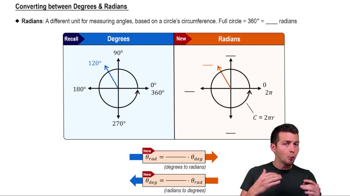
Recall that the quadrants in the coordinate plane are divided by the angles: Quadrant I (0 to \( \frac{\pi}{2} \)), Quadrant II (\( \frac{\pi}{2} \) to \( \pi \)), Quadrant III (\( \pi \) to \( \frac{3\pi}{2} \)), and Quadrant IV (\( \frac{3\pi}{2} \) to \( 2\pi \)).
Since the angle given is in radians, first find the equivalent angle between 0 and \( 2\pi \) by subtracting multiples of \( 2\pi \) from 7 until the result lies within this range.
Calculate \( 7 - 2\pi \) to find the coterminal angle between 0 and \( 2\pi \).
Determine which quadrant this coterminal angle lies in by comparing it to the quadrant boundaries: 0 to \( \frac{\pi}{2} \), \( \frac{\pi}{2} \) to \( \pi \), \( \pi \) to \( \frac{3\pi}{2} \), or \( \frac{3\pi}{2} \) to \( 2\pi \).
Conclude the quadrant where the terminal side of the angle lies based on the coterminal angle's position.
Verified video answer for a similar problem:
This video solution was recommended by our tutors as helpful for the problem above
Play a video:
0 Comments
Key Concepts
Here are the essential concepts you must grasp in order to answer the question correctly.
Standard Position of an Angle
An angle in standard position has its vertex at the origin and its initial side along the positive x-axis. The terminal side is determined by rotating the initial side counterclockwise for positive angles or clockwise for negative angles. Understanding this helps locate the angle's terminal side on the coordinate plane.
Radian measure quantifies angles based on the radius of a circle, where 2π radians equal 360 degrees. The unit circle is divided into four quadrants, each spanning π/2 radians. Knowing how to convert or compare radian values to these quadrant boundaries is essential to identify the terminal side's quadrant.
The coordinate plane is divided into four quadrants: Quadrant I (0 to π/2), Quadrant II (π/2 to π), Quadrant III (π to 3π/2), and Quadrant IV (3π/2 to 2π). Determining which quadrant an angle's terminal side lies in requires comparing the angle's radian measure to these intervals.

 Verified step by step guidance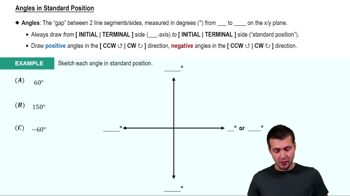
 05:50
05:50