Solve each equation over the interval [0, 2π). Write solutions as exact values or to four decimal places, as appropriate.
sin x/2 - cos x/2 = 0
Verified step by step guidance
1
Start with the given equation: \(\sin \frac{x}{2} - \cos \frac{x}{2} = 0\).
Rearrange the equation to isolate one trigonometric function: \(\sin \frac{x}{2} = \cos \frac{x}{2}\).
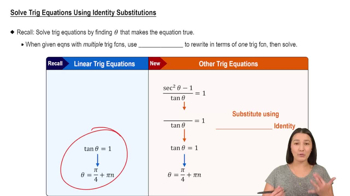
Divide both sides by \(\cos \frac{x}{2}\) (assuming \(\cos \frac{x}{2} \neq 0\)) to get \(\tan \frac{x}{2} = 1\).
Solve for \(\frac{x}{2}\) by finding the angles where \(\tan \theta = 1\) within the interval for \(\frac{x}{2}\), which is \([0, \pi)\) because \(x \in [0, 2\pi)\).
Multiply the solutions for \(\frac{x}{2}\) by 2 to find the corresponding values of \(x\) in the interval \([0, 2\pi)\).
Verified video answer for a similar problem:
This video solution was recommended by our tutors as helpful for the problem above
Play a video:
0 Comments
Key Concepts
Here are the essential concepts you must grasp in order to answer the question correctly.
Trigonometric Equations
Trigonometric equations involve functions like sine and cosine and require finding all angle values that satisfy the equation within a given interval. Solving these often involves algebraic manipulation and applying identities to isolate the variable.
When the variable appears as a fraction of the angle (e.g., x/2), it is helpful to use substitution (such as letting t = x/2) to simplify the equation. This allows solving for t first, then converting back to x, ensuring solutions fit the original interval.
Identities like sin A = cos A or sin A = cos(π/2 - A) help transform and simplify equations. Recognizing that sin θ = cos θ implies θ = π/4 + kπ enables finding exact solutions efficiently.