Evaluate each expression without using a calculator. sin (2 tan⁻¹ (12/5))
Verified step by step guidance
1
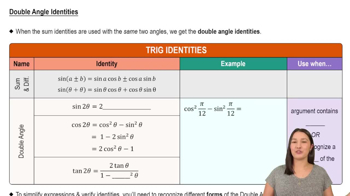
Recognize that the expression involves the double angle identity for sine: \( \sin(2\theta) = 2\sin(\theta)\cos(\theta) \).
Let \( \theta = \tan^{-1}(\frac{12}{5}) \). This means \( \tan(\theta) = \frac{12}{5} \).
Use the identity \( \sin(\theta) = \frac{\text{opposite}}{\text{hypotenuse}} \) and \( \cos(\theta) = \frac{\text{adjacent}}{\text{hypotenuse}} \) to find \( \sin(\theta) \) and \( \cos(\theta) \).
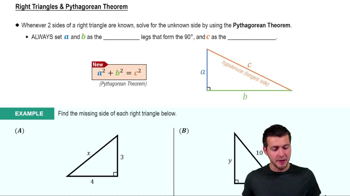
Construct a right triangle where the opposite side is 12 and the adjacent side is 5. Use the Pythagorean theorem to find the hypotenuse: \( \text{hypotenuse} = \sqrt{12^2 + 5^2} \).
Substitute \( \sin(\theta) \) and \( \cos(\theta) \) into the double angle identity: \( \sin(2\theta) = 2 \cdot \sin(\theta) \cdot \cos(\theta) \).
Verified video answer for a similar problem:
This video solution was recommended by our tutors as helpful for the problem above
Play a video:
Was this helpful?
Key Concepts
Here are the essential concepts you must grasp in order to answer the question correctly.
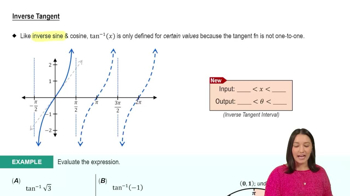
Inverse Tangent Function
The inverse tangent function, denoted as tan⁻¹ or arctan, is used to find an angle whose tangent is a given value. In this case, tan⁻¹(12/5) represents the angle whose tangent equals 12/5. Understanding this function is crucial for evaluating expressions involving angles derived from tangent values.
Double angle formulas are trigonometric identities that express trigonometric functions of double angles in terms of single angles. For example, sin(2θ) can be expressed as 2sin(θ)cos(θ). This concept is essential for simplifying expressions like sin(2 tan⁻¹(12/5)) by relating the sine of a double angle to the sine and cosine of the original angle.
Trigonometric ratios relate the angles of a triangle to the lengths of its sides. For a right triangle, the sine of an angle is the ratio of the length of the opposite side to the hypotenuse. In evaluating sin(2 tan⁻¹(12/5)), it is important to determine the sine and cosine values based on the triangle formed by the tangent ratio, which aids in calculating the final expression.