Evaluate each expression without using a calculator. sin (2 tan⁻¹ (12/5))
Verified step by step guidance
1
Recognize that the expression involves the sine of twice an angle, where the angle is given by \(\theta = \tan^{-1}\left(\frac{12}{5}\right)\). So, we want to find \(\sin(2\theta)\).
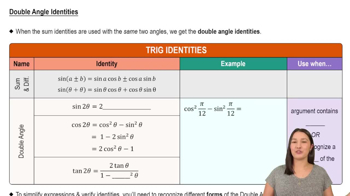
Recall the double-angle identity for sine: \(\sin(2\theta) = 2 \sin\theta \cos\theta\). This means we need to find \(\sin\theta\) and \(\cos\theta\) first.
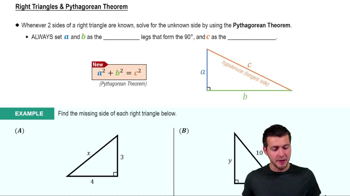
Since \(\theta = \tan^{-1}\left(\frac{12}{5}\right)\), imagine a right triangle where the opposite side to \(\theta\) is 12 and the adjacent side is 5. Use the Pythagorean theorem to find the hypotenuse: \(\text{hypotenuse} = \sqrt{12^2 + 5^2}\).
Calculate \(\sin\theta\) as \(\frac{\text{opposite}}{\text{hypotenuse}} = \frac{12}{\sqrt{12^2 + 5^2}}\) and \(\cos\theta\) as \(\frac{\text{adjacent}}{\text{hypotenuse}} = \frac{5}{\sqrt{12^2 + 5^2}}\).
Substitute \(\sin\theta\) and \(\cos\theta\) into the double-angle formula: \(\sin(2\theta) = 2 \times \frac{12}{\sqrt{12^2 + 5^2}} \times \frac{5}{\sqrt{12^2 + 5^2}}\). Simplify the expression to get the exact value.
Verified video answer for a similar problem:
This video solution was recommended by our tutors as helpful for the problem above
Play a video:
0 Comments
Key Concepts
Here are the essential concepts you must grasp in order to answer the question correctly.
Inverse Tangent Function (tan⁻¹ or arctan)
The inverse tangent function, tan⁻¹(x), gives the angle whose tangent is x. It is used to find an angle when the ratio of the opposite side to the adjacent side in a right triangle is known. Understanding this helps convert the given ratio 12/5 into an angle measure.
The double-angle identity for sine states that sin(2θ) = 2 sin θ cos θ. This formula allows us to express sin(2 tan⁻¹(x)) in terms of sine and cosine of the angle θ = tan⁻¹(x), facilitating evaluation without a calculator.
By interpreting tan⁻¹(12/5) as an angle in a right triangle with opposite side 12 and adjacent side 5, we can find the hypotenuse using the Pythagorean theorem. This enables calculation of exact sine and cosine values needed to apply the double-angle formula.

 Verified step by step guidance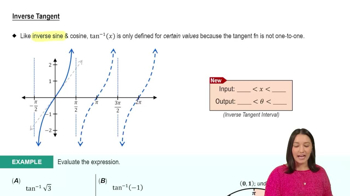
 3:17
3:17