Graph each function. See Examples 1 and 2.h(x) = |-½ x|
Verified step by step guidance
1
Step 1: Understand the function h(x) = |-\frac{1}{2}x|. This is an absolute value function, which means it will always output non-negative values regardless of the input.
Step 2: Recognize that the function inside the absolute value, -\frac{1}{2}x, is a linear function with a slope of -\frac{1}{2}. This means it decreases as x increases.
Step 3: Consider the effect of the absolute value. The graph of -\frac{1}{2}x would normally be a straight line with a negative slope, but the absolute value reflects any negative parts of the graph above the x-axis.
Step 4: Identify key points. For example, when x = 0, h(x) = 0. When x = 2, h(x) = 1, and when x = -2, h(x) = 1. These points help in sketching the graph.
Step 5: Sketch the graph. Start at the origin (0,0), and draw two lines: one going upwards to the right with a slope of \frac{1}{2}, and another going upwards to the left with a slope of \frac{1}{2}, forming a 'V' shape.
Verified video answer for a similar problem:
This video solution was recommended by our tutors as helpful for the problem above
Video duration:
6m
Play a video:
0 Comments
Key Concepts
Here are the essential concepts you must grasp in order to answer the question correctly.
Absolute Value Function
The absolute value function, denoted as |x|, outputs the non-negative value of x. This means that for any real number input, the function will return the distance of that number from zero on the number line, effectively removing any negative sign. Understanding this function is crucial for graphing h(x) = |-½ x|, as it will affect the shape and position of the graph.
Evaluate Composite Functions - Values Not on Unit Circle
Transformation of Functions
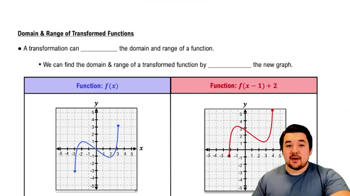
Transformations involve altering the basic shape of a function through shifts, stretches, or reflections. In the case of h(x) = |-½ x|, the factor of -½ indicates a horizontal stretch by a factor of 2 and a reflection across the y-axis. Recognizing these transformations helps in accurately sketching the graph of the function based on its parent function.
Graphing techniques involve plotting points and understanding the behavior of functions to create accurate visual representations. For h(x) = |-½ x|, it is essential to identify key points, such as where the function equals zero and its behavior as x approaches positive and negative infinity. Mastery of these techniques allows for a clear and precise graph of the function.