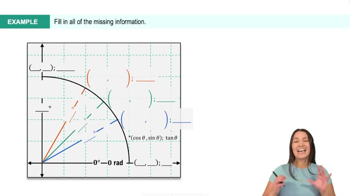
Write each vector in the form 〈a, b〉. Write answers using exact values or to four decimal places, as appropriate.
<IMAGE>
Verified step by step guidance
1
Identify the vectors in the image and note their components.
For each vector, determine the horizontal (x) and vertical (y) components.
Express each vector in the form \( \langle a, b \rangle \), where \( a \) is the horizontal component and \( b \) is the vertical component.
Ensure that the components are expressed using exact values or rounded to four decimal places, as appropriate.
Review the vectors to confirm that they are correctly expressed in the \( \langle a, b \rangle \) format.
Verified video answer for a similar problem:
This video solution was recommended by our tutors as helpful for the problem above
Play a video:
0 Comments
Key Concepts
Here are the essential concepts you must grasp in order to answer the question correctly.
Vectors
A vector is a mathematical object that has both magnitude and direction, often represented in the form 〈a, b〉, where 'a' is the horizontal component and 'b' is the vertical component. Vectors can be added, subtracted, and multiplied by scalars, making them essential in physics and engineering for representing quantities like force and velocity.
A coordinate system provides a framework for defining the position of points in space. In a two-dimensional Cartesian coordinate system, points are represented by ordered pairs (x, y), which correspond to horizontal and vertical distances from a reference point, typically the origin (0, 0). Understanding this system is crucial for accurately expressing vectors.
In mathematics, exact values refer to precise representations of numbers, such as fractions or radicals, while decimal approximations provide a rounded version of these values. When working with vectors, it is important to distinguish when to use exact values for clarity and precision, and when to round to a specified number of decimal places for practical applications.

 Verified step by step guidance
 03:48
03:48