Identify the given angle \( \theta = \frac{\pi}{9} \).
Substitute \( \theta \) into the cofunction identity: \( \tan\left(\frac{\pi}{9}\right) = \cot\left(\frac{\pi}{2} - \frac{\pi}{9}\right) \).
Simplify the expression inside the cotangent: \( \frac{\pi}{2} - \frac{\pi}{9} = \frac{9\pi}{18} - \frac{2\pi}{18} = \frac{7\pi}{18} \).
The cofunction with the same value is \( \cot\left(\frac{7\pi}{18}\right) \).
Verified video answer for a similar problem:
This video solution was recommended by our tutors as helpful for the problem above
Video duration:
2m
Play a video:
0 Comments
Key Concepts
Here are the essential concepts you must grasp in order to answer the question correctly.
Cofunction Identities
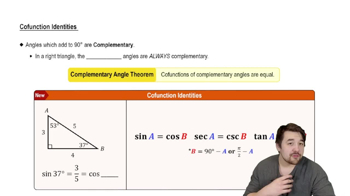
Cofunction identities relate the trigonometric functions of complementary angles. For example, the sine of an angle is equal to the cosine of its complement, and vice versa. This means that for any angle θ, sin(θ) = cos(90° - θ) and tan(θ) = cot(90° - θ). Understanding these identities is crucial for finding cofunctions with the same value.
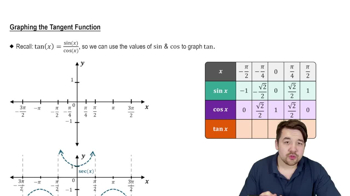
The tangent function, defined as the ratio of the sine and cosine functions (tan(θ) = sin(θ)/cos(θ)), is periodic and has specific values at key angles. It is important to know the values of the tangent function at standard angles (like 0°, 30°, 45°, 60°, and 90°) to effectively evaluate expressions and find cofunctions. In this case, tan(π/9) is the expression we need to analyze.
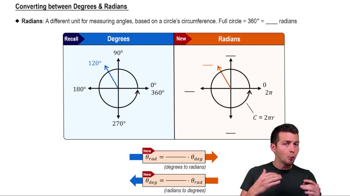
In trigonometry, angles can be measured in degrees or radians, with radians being the standard unit in most mathematical contexts. The angle π/9 radians corresponds to 20° (since π radians equals 180°). Understanding how to convert between these two systems is essential for evaluating trigonometric functions and applying cofunction identities correctly.

 2:37 minutes
 Verified step by step guidance
 6:30
6:30