Sea level refers to the surface of the ocean. The depth of a body of water can be expressed as a negative number, representing average depth in feet below sea level. The altitude of a mountain can be expressed as a positive number, indicating its height in feet above sea level. The table gives selected depths and altitudes. List the bodies of water in order, deepest to shallowest.
Table of contents
- 0. Review of College Algebra4h 45m
- 1. Measuring Angles40m
- 2. Trigonometric Functions on Right Triangles2h 5m
- 3. Unit Circle1h 19m
- 4. Graphing Trigonometric Functions1h 19m
- 5. Inverse Trigonometric Functions and Basic Trigonometric Equations1h 41m
- 6. Trigonometric Identities and More Equations2h 34m
- 7. Non-Right Triangles1h 38m
- 8. Vectors2h 25m
- 9. Polar Equations2h 5m
- 10. Parametric Equations1h 6m
- 11. Graphing Complex Numbers1h 7m
0. Review of College Algebra
Basics of Graphing
Problem 33b
Textbook Question
Concept Check Plot each point, and then plot the points that are symmetric to the given point with point with respect to the (b) y-axis (5, -3)
Verified step by step guidance1
Identify the given point as \((5, -3)\), where \$5\( is the \)x\(-coordinate and \)-3\( is the \)y$-coordinate.
Recall that symmetry with respect to the \(y\)-axis means reflecting the point across the \(y\)-axis. This changes the sign of the \(x\)-coordinate but keeps the \(y\)-coordinate the same.
Apply the reflection rule: For a point \((x, y)\), its symmetric point with respect to the \(y\)-axis is \((-x, y)\).
Using this rule, find the symmetric point of \((5, -3)\) by changing the \(x\)-coordinate from \$5\( to \)-5\(, while keeping the \)y\(-coordinate \)-3\( unchanged. So, the symmetric point is \)(-5, -3)$.
Plot both points on the coordinate plane: the original point \((5, -3)\) on the right side of the \(y\)-axis, and the symmetric point \((-5, -3)\) on the left side, at the same vertical level.
Verified video answer for a similar problem:This video solution was recommended by our tutors as helpful for the problem above
Play a video:
0 Comments
Key Concepts
Here are the essential concepts you must grasp in order to answer the question correctly.
Coordinate Plane and Plotting Points
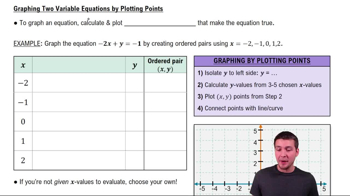
The coordinate plane is a two-dimensional surface defined by the x-axis (horizontal) and y-axis (vertical). Each point is represented by an ordered pair (x, y), where x indicates horizontal position and y indicates vertical position. Plotting a point involves locating its position based on these coordinates.
Recommended video:
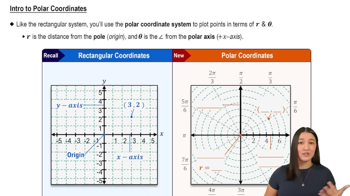
Convert Points from Polar to Rectangular
Symmetry with Respect to the y-Axis
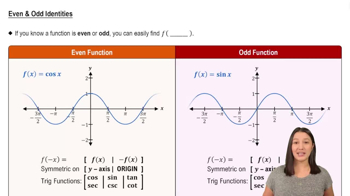
Symmetry about the y-axis means that for any point (x, y), its symmetric point has coordinates (-x, y). This reflects the point across the vertical y-axis, changing the sign of the x-coordinate while keeping the y-coordinate the same.
Recommended video:
Even and Odd Identities
Reflection of Points in the Coordinate Plane
Reflection involves creating a mirror image of a point across a specific axis. For the y-axis, reflection changes the x-coordinate's sign but leaves the y-coordinate unchanged. Understanding reflections helps in visualizing geometric transformations and solving related problems.
Recommended video:
Determining Different Coordinates for the Same Point
Related Videos
Related Practice
Textbook Question
5
views