Simplify each expression. See Example 4. cos² π/8 - 1/2
Verified step by step guidance
1
Recognize that the expression is \(\cos^{2} \frac{\pi}{8} - \frac{1}{2}\), where \(\cos^{2} \theta\) means \((\cos \theta)^2\).
Recall the double-angle identity for cosine: \(\cos 2\theta = 2\cos^{2} \theta - 1\). This can be rearranged to express \(\cos^{2} \theta\) as \(\cos^{2} \theta = \frac{1 + \cos 2\theta}{2}\).
Apply this identity to \(\cos^{2} \frac{\pi}{8}\) by substituting \(\theta = \frac{\pi}{8}\), so \(\cos^{2} \frac{\pi}{8} = \frac{1 + \cos \frac{\pi}{4}}{2}\).
Substitute this back into the original expression: \(\cos^{2} \frac{\pi}{8} - \frac{1}{2} = \frac{1 + \cos \frac{\pi}{4}}{2} - \frac{1}{2}\).
Simplify the expression by combining the fractions: \(\frac{1 + \cos \frac{\pi}{4} - 1}{2} = \frac{\cos \frac{\pi}{4}}{2}\). This is the simplified form in terms of cosine.
Verified video answer for a similar problem:
This video solution was recommended by our tutors as helpful for the problem above
Play a video:
0 Comments
Key Concepts
Here are the essential concepts you must grasp in order to answer the question correctly.
Pythagorean Identity
The Pythagorean identity states that for any angle θ, sin²θ + cos²θ = 1. This fundamental relationship allows us to express sine in terms of cosine and vice versa, which is useful for simplifying trigonometric expressions.
Half-angle formulas express trigonometric functions of half an angle in terms of the full angle. For cosine, cos²(θ) can be rewritten using cos(2θ) as cos²θ = (1 + cos 2θ)/2, which helps simplify expressions involving squared trigonometric functions.
Angles in trigonometry are often measured in radians, where π radians equal 180 degrees. Understanding radian measure is essential for correctly applying formulas and evaluating trigonometric functions at specific angles like π/8.

 Verified step by step guidance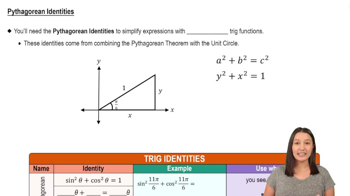
 6:25
6:25