Give two positive and two negative angles that are coterminal with the given quadrantal angle. 0°
Verified step by step guidance
1
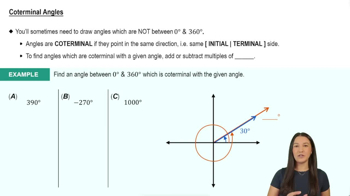
Understand that coterminal angles are angles that share the same terminal side when drawn in standard position.
To find coterminal angles, add or subtract multiples of 360° to the given angle.
For positive coterminal angles, add 360° to 0° to get the first positive angle, and then add another 360° to get the second positive angle.
For negative coterminal angles, subtract 360° from 0° to get the first negative angle, and then subtract another 360° to get the second negative angle.
Verify that all calculated angles are indeed coterminal by checking that they differ from the original angle by a multiple of 360°.
Verified video answer for a similar problem:
This video solution was recommended by our tutors as helpful for the problem above
Video duration:
2m
Play a video:
Was this helpful?
Key Concepts
Here are the essential concepts you must grasp in order to answer the question correctly.
Coterminal Angles
Coterminal angles are angles that share the same terminal side when drawn in standard position. To find coterminal angles, you can add or subtract multiples of 360° (for degrees) or 2π (for radians) to the given angle. For example, if you start with an angle of 0°, adding 360° gives you another coterminal angle of 360°, while subtracting 360° results in -360°.
Quadrantal angles are angles that lie on the axes of the coordinate plane, specifically at 0°, 90°, 180°, and 270° (or their equivalents in radians). These angles are significant in trigonometry because their sine and cosine values are well-defined and often used as reference points. The angle 0° is a quadrantal angle, making it a key reference for finding coterminal angles.
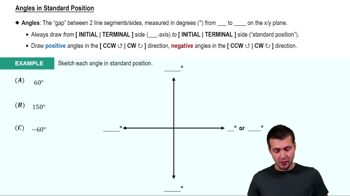
Positive angles are measured counterclockwise from the positive x-axis, while negative angles are measured clockwise. In the context of coterminal angles, both positive and negative angles can be derived from a given angle by adding or subtracting full rotations (360°). For instance, from 0°, you can find positive angles like 360° and negative angles like -360°.