Find the angle of least positive measure (not equal to the given measure) that is coterminal with each angle. See Example 5. ―541°
Verified step by step guidance
1
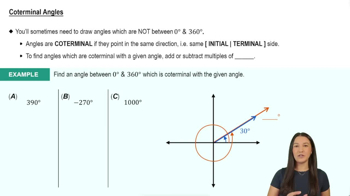
Understand that coterminal angles are angles that share the same terminal side when drawn in standard position. They differ by full rotations of 360°.
To find a coterminal angle, you can add or subtract multiples of 360° from the given angle.
Since we are given -541°, we need to find the least positive angle coterminal with it.
Add 360° to -541° repeatedly until the result is a positive angle.
Continue this process until you find the smallest positive angle that is coterminal with -541°.
Verified video answer for a similar problem:
This video solution was recommended by our tutors as helpful for the problem above
Video duration:
1m
Play a video:
Was this helpful?
Key Concepts
Here are the essential concepts you must grasp in order to answer the question correctly.
Coterminal Angles
Coterminal angles are angles that share the same terminal side when drawn in standard position, differing only by full rotations of 360 degrees. To find a coterminal angle, you can add or subtract multiples of 360° from the given angle. For example, -541° can be made coterminal by adding 360° until the angle is positive.
When tasked with finding the least positive angle coterminal with a given angle, the goal is to ensure the result is greater than zero. This often involves adding 360° repeatedly to a negative angle until a positive angle is achieved. The smallest positive angle is the desired result, ensuring it is not equal to the original angle.
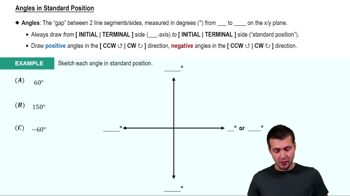
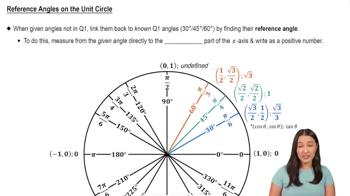
Angles can be measured in degrees or radians, with degrees being the more common unit in basic trigonometry. A full rotation is 360°, and angles can be positive (counterclockwise) or negative (clockwise). Understanding how to convert between these measurements and how they relate to the unit circle is essential for solving problems involving angles.