
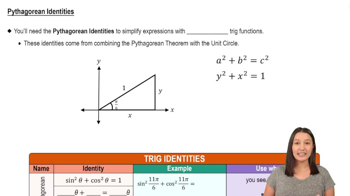
Substitute the given value of \(\cos \theta = \frac{5}{6}\) into the identity: \(\sin^{2} \theta + \left(\frac{5}{6}\right)^{2} = 1\).
Calculate \(\left(\frac{5}{6}\right)^{2}\) which is \(\frac{25}{36}\), so the equation becomes \(\sin^{2} \theta + \frac{25}{36} = 1\).
Isolate \(\sin^{2} \theta\) by subtracting \(\frac{25}{36}\) from both sides: \(\sin^{2} \theta = 1 - \frac{25}{36}\).
Since \(\theta\) is in quadrant I, where sine is positive, take the positive square root: \(\sin \theta = \sqrt{1 - \left(\frac{5}{6}\right)^{2}}\).
Verified video answer for a similar problem:
This video solution was recommended by our tutors as helpful for the problem above
Play a video:
0 Comments
Key Concepts
Here are the essential concepts you must grasp in order to answer the question correctly.
Pythagorean Identity
The Pythagorean identity states that sin²θ + cos²θ = 1 for any angle θ. This relationship allows you to find the sine of an angle if the cosine is known, by rearranging the formula to sin θ = ±√(1 - cos²θ).
The sign of sine and cosine depends on the quadrant where the angle lies. In quadrant I, both sine and cosine values are positive, which helps determine the correct sign when calculating sin θ from the Pythagorean identity.
Given cos θ = 5/6, you substitute this value into the Pythagorean identity to find sin θ. Since θ is in quadrant I, sin θ will be positive, so sin θ = √(1 - (5/6)²) = √(1 - 25/36) = √(11/36) = √11/6.