For Individual or Group Work (Exercises 147 – 150)In calculus, it is sometimes desirable to rationalize a numerator. To do this, we multiply the numerator and the denominator by the conjugate of the numerator. For example, (6 - √2)/4 = (6 - √2)/4 × (6 + √2)/(6 + √2) = (36 - 2)/(4(6 + √2)) = 34/(4(6 + √2)) = 17/(2(6 + √2)) = 17/(6 + √2). Rationalize each numerator. (6 - √3)/8
Table of contents
- 0. Review of College Algebra4h 45m
- 1. Measuring Angles40m
- 2. Trigonometric Functions on Right Triangles2h 5m
- 3. Unit Circle1h 19m
- 4. Graphing Trigonometric Functions1h 19m
- 5. Inverse Trigonometric Functions and Basic Trigonometric Equations1h 41m
- 6. Trigonometric Identities and More Equations2h 34m
- 7. Non-Right Triangles1h 38m
- 8. Vectors2h 25m
- 9. Polar Equations2h 5m
- 10. Parametric Equations1h 6m
- 11. Graphing Complex Numbers1h 7m
0. Review of College Algebra
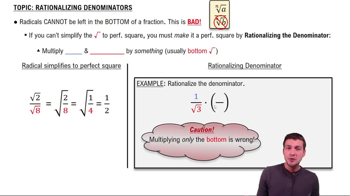
Rationalizing Denominators
Problem 9
Textbook Question
CONCEPT PREVIEW Perform the indicated operation, and write each answer in lowest terms 2x/5 + x/4
Verified step by step guidance1
Identify the given expression: \(\frac{2x}{5} + \frac{x}{4}\).
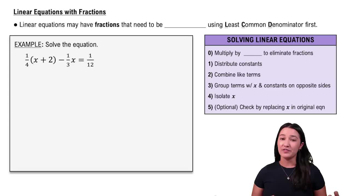
Find the least common denominator (LCD) of the fractions. Since the denominators are 5 and 4, the LCD is \$20$.
Rewrite each fraction with the denominator \$20$ by multiplying numerator and denominator appropriately: \(\frac{2x}{5} = \frac{2x \times 4}{5 \times 4} = \frac{8x}{20}\) and \(\frac{x}{4} = \frac{x \times 5}{4 \times 5} = \frac{5x}{20}\).
Add the numerators over the common denominator: \(\frac{8x}{20} + \frac{5x}{20} = \frac{8x + 5x}{20} = \frac{13x}{20}\).
Check if the fraction \(\frac{13x}{20}\) can be simplified further by factoring numerator and denominator; since 13 is prime and does not divide 20, the expression is already in lowest terms.
Verified video answer for a similar problem:This video solution was recommended by our tutors as helpful for the problem above
Video duration:
1mPlay a video:
0 Comments
Key Concepts
Here are the essential concepts you must grasp in order to answer the question correctly.
Adding Rational Expressions
Adding rational expressions involves combining fractions with variable expressions in the numerator and denominator. To add them, you must find a common denominator, rewrite each fraction with this denominator, and then add the numerators while keeping the denominator the same.
Recommended video:
Rationalizing Denominators
Finding the Least Common Denominator (LCD)
The least common denominator is the smallest expression that both denominators divide into evenly. Identifying the LCD allows you to rewrite each fraction with a common denominator, which is essential for performing addition or subtraction of rational expressions.
Recommended video:
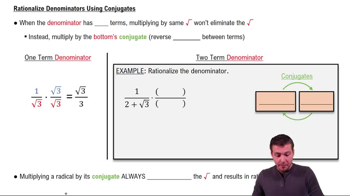
Rationalizing Denominators Using Conjugates
Simplifying Rational Expressions
After performing operations on rational expressions, simplifying involves factoring numerators and denominators and canceling common factors. This process reduces the expression to its lowest terms, making the answer clearer and more concise.
Recommended video:
Rationalizing Denominators
Related Videos
Related Practice
Textbook Question
714
views