Graph each function over a two-period interval. y = sin (x + π/4)
Verified step by step guidance
1
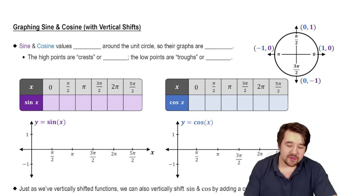
Identify the basic function: The function given is a sine function, which is periodic with a period of \$2\pi$.
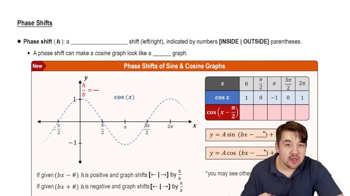
Determine the phase shift: The function \(y = \sin(x + \pi/4)\) has a phase shift of \(-\pi/4\). This means the graph of the sine function is shifted to the left by \(\pi/4\) units.
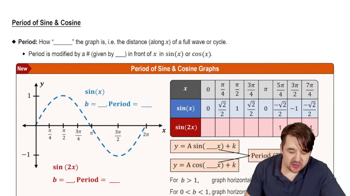
Determine the period: The period of the sine function is \$2\pi\(. Since there is no coefficient affecting the \)x\( inside the sine function, the period remains \)2\pi$.
Graph over two periods: Since the period is \$2\pi\(, two periods would be \)4\pi\(. Start graphing from \)x = -\pi/4\( (due to the phase shift) and continue until \)x = 4\pi - \pi/4$.
Plot key points: Identify and plot key points such as the maximum, minimum, and intercepts within the interval. These occur at \(x = -\pi/4, \pi/4, 3\pi/4, 5\pi/4, \ldots\) and so on, considering the phase shift.
Verified video answer for a similar problem:
This video solution was recommended by our tutors as helpful for the problem above
Play a video:
Was this helpful?
Key Concepts
Here are the essential concepts you must grasp in order to answer the question correctly.
Sine Function
The sine function is a fundamental trigonometric function defined as the ratio of the length of the opposite side to the hypotenuse in a right triangle. It is periodic with a period of 2π, meaning it repeats its values every 2π units. The sine function oscillates between -1 and 1, making it essential for modeling wave-like phenomena.
Phase shift refers to the horizontal shift of a periodic function along the x-axis. In the function y = sin(x + π/4), the term π/4 indicates a leftward shift of the sine wave by π/4 units. Understanding phase shifts is crucial for accurately graphing trigonometric functions and analyzing their behavior.
Graphing trigonometric functions involves plotting their values over a specified interval. For y = sin(x + π/4), one must consider the amplitude, period, and phase shift to create an accurate representation. Graphing over a two-period interval (0 to 4π) allows for a complete view of the function's oscillatory nature and helps in visualizing its transformations.