Use a calculator to approximate each real number value. (Be sure the calculator is in radian mode.) y = sec⁻¹ (―1.2871684)
Verified step by step guidance
1
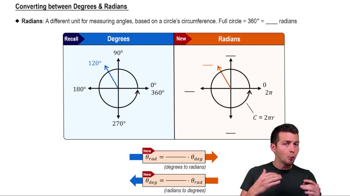
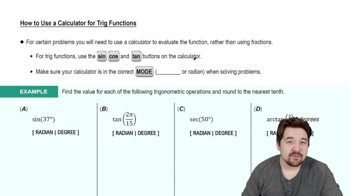
Ensure your calculator is in radian mode, as the problem specifies the use of radians.
Understand that \( \sec^{-1}(x) \) is the inverse secant function, which gives the angle whose secant is \( x \).
Recall that \( \sec(\theta) = \frac{1}{\cos(\theta)} \), so \( \sec^{-1}(x) \) is equivalent to finding \( \theta \) such that \( \cos(\theta) = \frac{1}{x} \).
Calculate \( \cos(\theta) = \frac{1}{-1.2871684} \) to find the cosine of the angle.
Use the inverse cosine function on your calculator to find \( \theta = \cos^{-1}\left(\frac{1}{-1.2871684}\right) \).
Verified video answer for a similar problem:
This video solution was recommended by our tutors as helpful for the problem above
Play a video:
0 Comments
Key Concepts
Here are the essential concepts you must grasp in order to answer the question correctly.
Inverse Secant Function
The inverse secant function, denoted as sec⁻¹ or arcsec, is the inverse of the secant function. It is defined for values outside the interval (-1, 1), as sec(x) = 1/cos(x). The output of the inverse secant function is an angle whose secant is the given value, and it typically returns values in the range [0, π/2) ∪ (π/2, π].
Radian mode is a setting on calculators that allows angles to be measured in radians instead of degrees. Radians are a unit of angular measure where one radian is the angle subtended at the center of a circle by an arc equal in length to the radius. This mode is essential for trigonometric calculations involving functions like sine, cosine, and secant, especially when working with calculus or higher-level mathematics.
Understanding how to use a scientific calculator is crucial for approximating values of trigonometric functions. Most calculators have specific buttons for inverse functions, including sec⁻¹. Familiarity with the calculator's interface and functions ensures accurate input and interpretation of results, especially when switching between radian and degree modes.


 Verified step by step guidance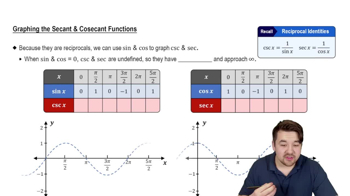
 6:22
6:22