Recognize that the given expression matches the tangent double-angle identity, which is: \(\tan(2\theta) = \frac{2 \tan \theta}{1 - \tan^2 \theta}\).
Identify \(\theta\) in the expression. Here, \(\theta = 15^\circ\) because the expression is \(\frac{2 \tan 15^\circ}{1 - \tan^2 15^\circ}\).
Apply the double-angle formula by substituting \(\theta = 15^\circ\) into \(\tan(2\theta)\), so the expression simplifies to \(\tan(30^\circ)\).
Recall or use known values or properties of tangent to understand that \(\tan(30^\circ)\) is a standard angle value.
Conclude that the original expression simplifies to \(\tan(30^\circ)\), which can be further evaluated if needed.
Verified video answer for a similar problem:
This video solution was recommended by our tutors as helpful for the problem above
Play a video:
0 Comments
Key Concepts
Here are the essential concepts you must grasp in order to answer the question correctly.
Tangent Double-Angle Identity
The tangent double-angle identity states that tan(2θ) = (2 tan θ) / (1 - tan² θ). This formula allows simplification of expressions involving tangent of double angles by relating them to the tangent of the original angle.
Simplifying trigonometric expressions involves applying identities and algebraic manipulation to rewrite expressions in simpler or more recognizable forms. This process often helps in solving equations or evaluating values more easily.
Knowing or calculating the tangent of specific angles, such as 15°, is essential for evaluating expressions numerically or verifying simplified forms. This can be done using known angle values or by using sum and difference formulas.

 Verified step by step guidance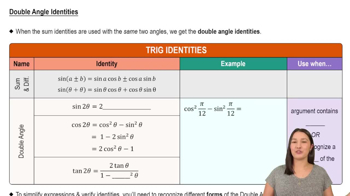
 05:06
05:06