CONCEPT PREVIEW Work each problem. Match each polynomial in Column I with its factored form in Column II. I II a. x² + 10xy + 25y² A. (x + 5y) (x - 5y) b. x² - 10xy + 25y² B. (x + 5y)² c. x² - 25y² C. (x - 5y)² d. 25y² - x² D. (5y + x) (5y - x)
Table of contents
- 0. Review of College Algebra4h 45m
- 1. Measuring Angles40m
- 2. Trigonometric Functions on Right Triangles2h 5m
- 3. Unit Circle1h 19m
- 4. Graphing Trigonometric Functions1h 19m
- 5. Inverse Trigonometric Functions and Basic Trigonometric Equations1h 41m
- 6. Trigonometric Identities and More Equations2h 34m
- 7. Non-Right Triangles1h 38m
- 8. Vectors2h 25m
- 9. Polar Equations2h 5m
- 10. Parametric Equations1h 6m
- 11. Graphing Complex Numbers1h 7m
0. Review of College Algebra
Solving Linear Equations
Problem 13
Textbook Question
Simplify each expression. See Example 1. n⁶ • n⁴ • n
Verified step by step guidance1
Identify the base and the exponents in the expression \(n^{6} \cdot n^{4} \cdot n\). Here, the base is \(n\) for all terms.
Recall the exponent rule for multiplication with the same base: \(a^{m} \cdot a^{n} = a^{m+n}\). This means you add the exponents when multiplying powers with the same base.
Rewrite the expression by explicitly showing the exponents: \(n^{6} \cdot n^{4} \cdot n^{1}\) (since \(n\) is the same as \(n^{1}\)).
Add the exponents together: \$6 + 4 + 1$ to get the new exponent.
Express the simplified form as \(n^{6+4+1}\), which is \(n^{11}\), but do not calculate the sum explicitly here as per instructions.
Verified video answer for a similar problem:This video solution was recommended by our tutors as helpful for the problem above
Video duration:
2mPlay a video:
0 Comments
Key Concepts
Here are the essential concepts you must grasp in order to answer the question correctly.
Laws of Exponents
The laws of exponents govern how to simplify expressions involving powers of the same base. Specifically, when multiplying terms with the same base, you add their exponents. For example, n^a * n^b = n^(a+b). This rule is essential for simplifying expressions like n⁶ • n⁴ • n.
Recommended video:
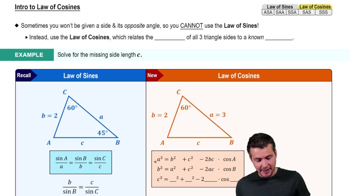
Intro to Law of Cosines
Base Consistency in Exponentiation
When applying exponent rules, the base must be the same for the rules to hold. In the expression n⁶ • n⁴ • n, all terms share the base 'n', allowing the exponents to be combined. Recognizing consistent bases is crucial before performing operations on exponents.
Recommended video:
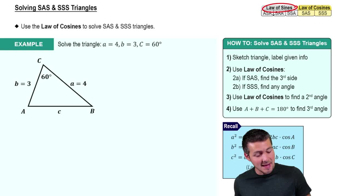
Solving SAS & SSS Triangles
Simplification of Algebraic Expressions
Simplification involves rewriting expressions in a more compact or standard form without changing their value. For powers, this means combining like terms and reducing the expression to a single term when possible, such as combining n⁶ • n⁴ • n into n^(6+4+1) = n¹¹.
Recommended video:
Simplifying Trig Expressions
Related Videos
Related Practice
Textbook Question
461
views