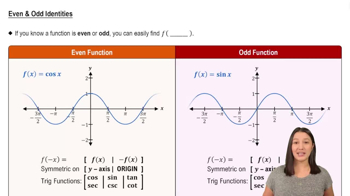
Identify the basic trigonometric function graphed, and determine whether it is even or odd.
<IMAGE>
Verified step by step guidance
1
Step 1: Observe the shape of the graphed function. Identify if it resembles the sine wave (which starts at zero and goes up) or the cosine wave (which starts at a maximum or minimum).
Step 2: Recall the basic properties of sine and cosine functions: sine is an odd function, meaning \(\sin(-x) = -\sin(x)\), and cosine is an even function, meaning \(\cos(-x) = \cos(x)\).
Step 3: Check the symmetry of the graph. If the graph is symmetric about the y-axis, the function is even. If it is symmetric about the origin, the function is odd.
Step 4: Match the graph's starting point and symmetry to the corresponding basic trigonometric function (sine or cosine) and determine its parity (even or odd).
Step 5: Conclude by stating the identified function and whether it is even or odd based on the observations and properties.
Verified video answer for a similar problem:
This video solution was recommended by our tutors as helpful for the problem above
Play a video:
0 Comments
Key Concepts
Here are the essential concepts you must grasp in order to answer the question correctly.
Basic Trigonometric Functions
The primary trigonometric functions are sine, cosine, and tangent, each representing ratios of sides in a right triangle or coordinates on the unit circle. Recognizing their characteristic waveforms—sine and cosine as smooth periodic waves and tangent with vertical asymptotes—is essential for identifying graphed functions.
A function is even if f(-x) = f(x), meaning its graph is symmetric about the y-axis. It is odd if f(-x) = -f(x), showing symmetry about the origin. Understanding these properties helps classify trigonometric functions: cosine is even, sine and tangent are odd.
Graphical Characteristics of Trigonometric Functions
Each trig function has distinct graph features: sine starts at zero and oscillates between -1 and 1, cosine starts at 1, and tangent has repeating vertical asymptotes. Identifying these traits in a graph aids in determining the function type and its symmetry.

 Verified step by step guidance
 6:04
6:04