Use a calculator to approximate each value in decimal degrees. θ = arcsec 3.4723155
Verified step by step guidance
1
Step 1: Understand the problem. We need to find the angle \( \theta \) in decimal degrees such that \( \theta = \text{arcsec}(3.4723155) \).
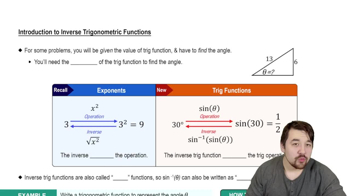
Step 2: Recall the definition of arcsecant. The arcsecant function, \( \text{arcsec}(x) \), is the inverse of the secant function. It gives the angle whose secant is \( x \).
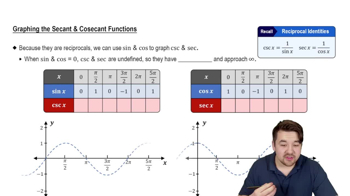
Step 3: Use the relationship between secant and cosine. Since \( \sec(\theta) = x \), we have \( \cos(\theta) = \frac{1}{x} \). Therefore, \( \cos(\theta) = \frac{1}{3.4723155} \).
Step 4: Calculate \( \cos(\theta) \) using a calculator. Find the value of \( \frac{1}{3.4723155} \) to determine \( \cos(\theta) \).
Step 5: Use a calculator to find \( \theta \) in degrees. Use the inverse cosine function, \( \theta = \cos^{-1}(\frac{1}{3.4723155}) \), to find the angle in decimal degrees.
Verified video answer for a similar problem:
This video solution was recommended by our tutors as helpful for the problem above
Play a video:
Was this helpful?
Key Concepts
Here are the essential concepts you must grasp in order to answer the question correctly.
Arcsecant Function
The arcsecant function, denoted as arcsec or sec^-1, is the inverse of the secant function. It is defined for values of x where |x| ≥ 1, and it returns an angle θ such that sec(θ) = x. Understanding this function is crucial for solving problems involving angles derived from secant values.
Using a scientific calculator effectively is essential for approximating trigonometric values. Most calculators have specific functions for inverse trigonometric operations, including arcsec. Familiarity with how to input values and interpret results in decimal degrees is necessary for accurate calculations.
Trigonometric functions can be expressed in degrees or radians, which are two different units for measuring angles. In this context, the question specifies decimal degrees, so it is important to ensure that the calculator is set to the correct mode to avoid conversion errors when interpreting the results of the arcsec function.