Evaluate each expression without using a calculator. arccos (cos (3π/4))
Verified step by step guidance
1
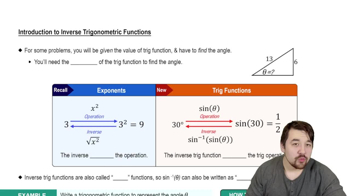
Understand that \( \arccos(x) \) is the inverse function of \( \cos(x) \), meaning \( \arccos(\cos(x)) = x \) if \( x \) is within the range of \( \arccos \), which is \([0, \pi]\).
Recognize that \( 3\pi/4 \) is within the range \([0, \pi]\), so we can directly apply the property of inverse functions.
Since \( 3\pi/4 \) is within the range of \( \arccos \), the expression simplifies to \( 3\pi/4 \).
Verify that \( \cos(3\pi/4) \) is indeed a valid input for \( \arccos \) by checking that it lies within the range \([-1, 1]\).
Conclude that \( \arccos(\cos(3\pi/4)) = 3\pi/4 \) because \( 3\pi/4 \) is within the range of the \( \arccos \) function.
Verified video answer for a similar problem:
This video solution was recommended by our tutors as helpful for the problem above
Play a video:
Was this helpful?
Key Concepts
Here are the essential concepts you must grasp in order to answer the question correctly.
Inverse Trigonometric Functions
Inverse trigonometric functions, such as arccos, are used to find the angle whose cosine is a given value. For example, arccos(x) returns the angle θ in the range [0, π] such that cos(θ) = x. Understanding how these functions operate is crucial for evaluating expressions involving them.
The cosine function, cos(θ), gives the x-coordinate of a point on the unit circle corresponding to the angle θ. For angles like 3π/4, which is in the second quadrant, the cosine value is negative. Recognizing the values of cosine for common angles helps in simplifying expressions involving trigonometric functions.
The principal value of an inverse function refers to the specific output range that the function adheres to. For arccos, the principal value is restricted to [0, π]. This means that when evaluating arccos(cos(3π/4)), one must consider the angle's position within this range to find the correct output.