Use the given information to find each of the following. cot θ/2, given tan θ = -(√5)/2 , with 90° < θ < 180°
Verified step by step guidance
1
Identify that \( \theta \) is in the second quadrant, where tangent is negative and cotangent is also negative.
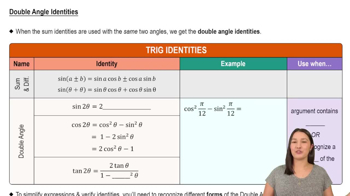
Use the identity for tangent of half-angle: \( \tan \frac{\theta}{2} = \pm \sqrt{\frac{1 - \cos \theta}{1 + \cos \theta}} \).
Since \( \tan \theta = -\frac{\sqrt{5}}{2} \), use the identity \( \tan \theta = \frac{\sin \theta}{\cos \theta} \) to express \( \sin \theta \) and \( \cos \theta \) in terms of each other.
Use the Pythagorean identity \( \sin^2 \theta + \cos^2 \theta = 1 \) to find \( \cos \theta \).
Calculate \( \cot \frac{\theta}{2} = \frac{1}{\tan \frac{\theta}{2}} \) using the value of \( \tan \frac{\theta}{2} \) obtained from the half-angle identity.>
Verified video answer for a similar problem:
This video solution was recommended by our tutors as helpful for the problem above
Play a video:
Was this helpful?
Key Concepts
Here are the essential concepts you must grasp in order to answer the question correctly.
Trigonometric Functions
Trigonometric functions, such as sine, cosine, tangent, and their reciprocals (cosecant, secant, cotangent), relate angles to ratios of sides in right triangles. Understanding these functions is essential for solving problems involving angles and their relationships, particularly in different quadrants of the unit circle.
The unit circle is divided into four quadrants, each corresponding to specific ranges of angle measures. For angles between 90° and 180°, both sine and cosine are negative, while tangent is positive. Recognizing the quadrant in which an angle lies helps determine the signs of the trigonometric functions involved.
Half-angle identities are formulas that express trigonometric functions of half an angle in terms of the functions of the original angle. For example, cot(θ/2) can be derived using the identity cot(θ/2) = (1 + cos(θ)) / sin(θ). These identities are crucial for simplifying expressions and solving for angles in trigonometric equations.