Use a half-angle identity to find each exact value. sin 165°
Verified step by step guidance
1
Recognize that 165° can be expressed as 330°/2, which allows us to use the half-angle identity for sine.
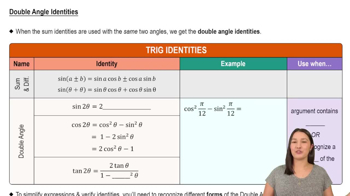
Recall the half-angle identity for sine: \( \sin \left( \frac{\theta}{2} \right) = \pm \sqrt{\frac{1 - \cos \theta}{2}} \).
Determine the correct sign for the sine function in the second quadrant, where 165° is located. Since sine is positive in the second quadrant, use the positive sign.
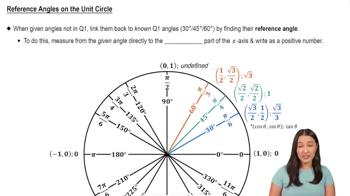
Calculate \( \cos 330° \) using the cosine of a known angle: \( \cos 330° = \cos(360° - 30°) = \cos 30° = \frac{\sqrt{3}}{2} \).
Substitute \( \cos 330° \) into the half-angle identity: \( \sin 165° = \sqrt{\frac{1 - \frac{\sqrt{3}}{2}}{2}} \). Simplify the expression to find the exact value.
Verified video answer for a similar problem:
This video solution was recommended by our tutors as helpful for the problem above
Play a video:
Was this helpful?
Key Concepts
Here are the essential concepts you must grasp in order to answer the question correctly.
Half-Angle Identities
Half-angle identities are trigonometric formulas that express the sine, cosine, and tangent of half an angle in terms of the trigonometric functions of the original angle. For sine, the identity is sin(θ/2) = ±√((1 - cos(θ))/2). These identities are particularly useful for finding exact values of trigonometric functions at angles that are not standard, such as 165°.
A reference angle is the acute angle formed by the terminal side of an angle and the x-axis. For angles greater than 90° but less than 360°, the reference angle helps in determining the sine, cosine, and tangent values by relating them to the corresponding acute angle. For sin(165°), the reference angle is 15°, which is essential for applying the half-angle identity.
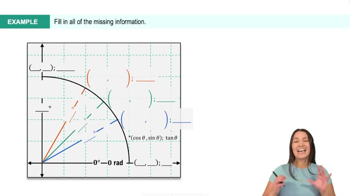
Exact values of trigonometric functions refer to the precise values of sine, cosine, and tangent for specific angles, often expressed in terms of square roots. For example, sin(30°) = 1/2 and cos(45°) = √2/2. Knowing these exact values allows for the simplification of expressions and calculations when using identities, such as when calculating sin(165°) using the half-angle identity.