Solve each problem. See Examples 1 and 2. Distance Traveled by a Ship A ship travels 55 km on a bearing of 27° and then travels on a bearing of 117° for 140 km. Find the distance from the starting point to the ending point.
Table of contents
- 0. Review of College Algebra4h 45m
- 1. Measuring Angles40m
- 2. Trigonometric Functions on Right Triangles2h 5m
- 3. Unit Circle1h 19m
- 4. Graphing Trigonometric Functions1h 19m
- 5. Inverse Trigonometric Functions and Basic Trigonometric Equations1h 41m
- 6. Trigonometric Identities and More Equations2h 34m
- 7. Non-Right Triangles1h 38m
- 8. Vectors2h 25m
- 9. Polar Equations2h 5m
- 10. Parametric Equations1h 6m
- 11. Graphing Complex Numbers1h 7m
2. Trigonometric Functions on Right Triangles
Trigonometric Functions on Right Triangles
Problem 2.5.25
Textbook Question
Solve each problem. See Examples 1 and 2. Distance between Two Ships A ship leaves its home port and sails on a bearing of S 61°50'. Another ship leaves the same port at the same time and sails on a bearing of N 28°10'E. If the first ship sails at 24.0 mph and the second sails at 28.0 mph, find the distance between the two ships after 4 hr.
Verified step by step guidance1
Convert the bearings into standard angles measured counterclockwise from the positive x-axis (East). For the first ship with bearing S 61°50', this corresponds to an angle of 180° + 61°50' (since it's measured clockwise from North to South), so calculate the exact angle in degrees. For the second ship with bearing N 28°10' E, this corresponds to an angle of 90° - 28°10' (since it's measured clockwise from North to East), so calculate this angle as well.
Calculate the distance each ship has traveled after 4 hours by multiplying their speeds by time: Distance = Speed × Time. For the first ship, multiply 24.0 mph by 4 hours; for the second ship, multiply 28.0 mph by 4 hours.
Express the position of each ship in Cartesian coordinates (x, y) using their distances and angles. Use the formulas: \(x = r \times \cos(\theta)\) and \(y = r \times \sin(\theta)\), where \(r\) is the distance traveled and \(\theta\) is the angle in radians (convert degrees to radians).
Find the difference in the x-coordinates and y-coordinates between the two ships to get the components of the vector representing the distance between them: \(\Delta x = x_2 - x_1\) and \(\Delta y = y_2 - y_1\).
Use the Pythagorean theorem to find the distance between the two ships: \(\text{Distance} = \sqrt{(\Delta x)^2 + (\Delta y)^2}\). This will give the straight-line distance between the ships after 4 hours.
Verified video answer for a similar problem:This video solution was recommended by our tutors as helpful for the problem above
Video duration:
4mPlay a video:
0 Comments
Key Concepts
Here are the essential concepts you must grasp in order to answer the question correctly.
Bearing and Direction in Navigation
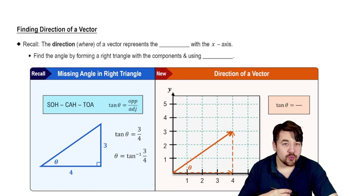
Bearing is a way to describe direction using angles measured clockwise from the north or south line. Bearings like S 61°50' mean starting from south and rotating 61°50' towards the east. Understanding how to convert these bearings into standard angles or vectors is essential for plotting the ships' courses accurately.
Recommended video:
Finding Direction of a Vector
Vector Representation of Displacement
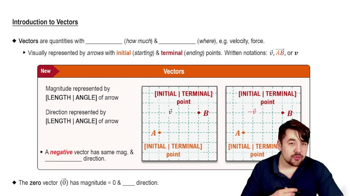
Each ship's movement can be represented as a vector based on its speed, time traveled, and direction (bearing). Calculating the displacement vectors allows us to find the ships' positions relative to the port after 4 hours, which is necessary to determine the distance between them.
Recommended video:
Introduction to Vectors
Law of Cosines for Distance Calculation
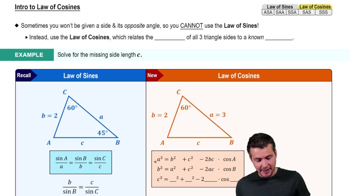
When two vectors form an angle, the distance between their endpoints can be found using the Law of Cosines. This law relates the lengths of two sides of a triangle and the included angle to find the third side, which in this problem is the distance between the two ships after traveling.
Recommended video:
Intro to Law of Cosines
Related Videos
Related Practice
Textbook Question
844
views