In Exercises 55–62, use the properties of inverse functions f(f⁻¹ (x)) = x for all x in the domain of f⁻¹ and f⁻¹(f(x)) for all x in the domain of f, as well as the definitions of the inverse cotangent, cosecant, and secant functions, to find the exact value of each expression, if possible.cot⁻¹ (cot 3π/4)
Verified step by step guidance
1
Identify the function and its inverse: Here, we have the inverse cotangent function \( \cot^{-1} \) and the cotangent function \( \cot \).
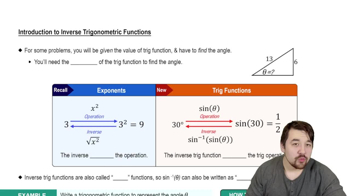
Recall the property of inverse functions: \( f(f^{-1}(x)) = x \) for all \( x \) in the domain of \( f^{-1} \) and \( f^{-1}(f(x)) = x \) for all \( x \) in the domain of \( f \).
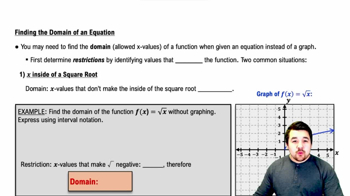
Determine the domain of \( \cot \): The cotangent function is defined for all real numbers except where \( \sin(x) = 0 \), i.e., \( x \neq n\pi \) where \( n \) is an integer.
Determine the range of \( \cot^{-1} \): The range of the inverse cotangent function is \( (0, \pi) \).
Evaluate \( \cot^{-1}(\cot(3\pi/4)) \): Since \( 3\pi/4 \) is within the range of \( \cot^{-1} \), the expression simplifies to \( 3\pi/4 \).
Verified video answer for a similar problem:
This video solution was recommended by our tutors as helpful for the problem above
Video duration:
1m
Play a video:
Was this helpful?
Key Concepts
Here are the essential concepts you must grasp in order to answer the question correctly.
Inverse Functions
Inverse functions are pairs of functions that 'undo' each other. For a function f and its inverse f⁻¹, the property f(f⁻¹(x)) = x holds true for all x in the domain of f⁻¹, and f⁻¹(f(x)) = x for all x in the domain of f. This means that applying a function and then its inverse returns the original value, which is crucial for solving problems involving inverse trigonometric functions.
Inverse trigonometric functions, such as cot⁻¹, sec⁻¹, and csc⁻¹, are used to find angles when given a trigonometric ratio. For example, cot⁻¹(x) gives the angle whose cotangent is x. These functions have specific ranges to ensure they are single-valued, which is essential for determining exact values in trigonometric expressions.
The cotangent function, defined as cot(θ) = 1/tan(θ) or cot(θ) = cos(θ)/sin(θ), is the reciprocal of the tangent function. Understanding the cotangent function is vital for evaluating expressions like cot⁻¹(cot(3π/4)), as it helps to determine the angle corresponding to a given cotangent value. The angle 3π/4 is in the second quadrant, where cotangent is negative, influencing the output of the inverse function.