Textbook Question
In Exercises 53–54, let f(x) = 2 sec x, g(x) = −2 tan x, and h(x) = 2x − π/2. Graph two periods of y = (f∘h)(x).
733
views

 Blitzer 3rd EditionCh. 2 - Graphs of the Trigonometric Functions; Inverse Trigonometric FunctionsProblem 53
 Verified step by step guidance
 4:03
4:03
 04:39
04:39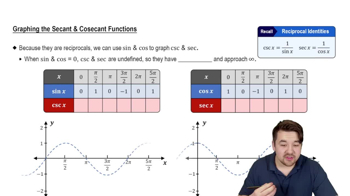 6:22
6:22In Exercises 53–54, let f(x) = 2 sec x, g(x) = −2 tan x, and h(x) = 2x − π/2. Graph two periods of y = (f∘h)(x).
In Exercises 55–62, use the properties of inverse functions f(f⁻¹ (x)) = x for all x in the domain of f⁻¹ and f⁻¹(f(x)) for all x in the domain of f, as well as the definitions of the inverse cotangent, cosecant, and secant functions, to find the exact value of each expression, if possible. cot(cot⁻¹ 9π)
In Exercises 54–57, solve the right triangle shown in the figure. Round lengths to two decimal places and express angles to the nearest tenth of a degree. A = 22.3°, c = 10
In Exercises 53–60, use a vertical shift to graph one period of the function. y = sin x + 2
In Exercises 39–54, find the exact value of each expression, if possible. Do not use a calculator. sin(sin⁻¹ π)
In Exercises 39–54, find the exact value of each expression, if possible. Do not use a calculator. sin⁻¹ (sin π)