In Exercises 55–62, use the properties of inverse functions f(f⁻¹ (x)) = x for all x in the domain of f⁻¹ and f⁻¹(f(x)) for all x in the domain of f, as well as the definitions of the inverse cotangent, cosecant, and secant functions, to find the exact value of each expression, if possible.cot⁻¹ (cot 3π/4)
Verified step by step guidance
1
Identify the function and its inverse: Here, we have the inverse cotangent function \( \cot^{-1} \) and the cotangent function \( \cot \).
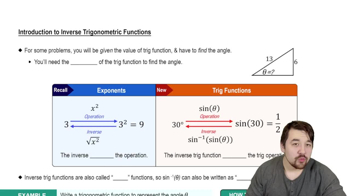
Recall the property of inverse functions: \( f(f^{-1}(x)) = x \) for all \( x \) in the domain of \( f^{-1} \) and \( f^{-1}(f(x)) = x \) for all \( x \) in the domain of \( f \).
Determine the domain of \( \cot \): The cotangent function is defined for all real numbers except where \( \sin(x) = 0 \), i.e., \( x \neq n\pi \) where \( n \) is an integer.
Determine the range of \( \cot^{-1} \): The range of the inverse cotangent function is \( (0, \pi) \).
Evaluate \( \cot^{-1}(\cot(3\pi/4)) \): Since \( 3\pi/4 \) is within the range of \( \cot^{-1} \), the expression simplifies to \( 3\pi/4 \).
Verified video answer for a similar problem:
This video solution was recommended by our tutors as helpful for the problem above
Video duration:
1m
Play a video:
Key Concepts
Here are the essential concepts you must grasp in order to answer the question correctly.
Inverse Functions
Inverse functions are pairs of functions that 'undo' each other. For a function f and its inverse f⁻¹, the property f(f⁻¹(x)) = x holds true for all x in the domain of f⁻¹, and f⁻¹(f(x)) = x for all x in the domain of f. This means that applying a function and then its inverse returns the original value, which is crucial for solving problems involving inverse trigonometric functions.
Inverse trigonometric functions, such as cot⁻¹, sec⁻¹, and csc⁻¹, are used to find angles when given a trigonometric ratio. For example, cot⁻¹(x) gives the angle whose cotangent is x. These functions have specific ranges to ensure they are single-valued, which is essential for determining exact values in trigonometric expressions.
The cotangent function, defined as cot(θ) = 1/tan(θ) or cot(θ) = cos(θ)/sin(θ), is the reciprocal of the tangent function. Understanding the cotangent function is vital for evaluating expressions like cot⁻¹(cot(3π/4)), as it helps to determine the angle corresponding to a given cotangent value. The angle 3π/4 is in the second quadrant, where cotangent is negative, influencing the output of the inverse function.