Identify that in the given expression, \( 20\alpha \) is playing the role of \( 2\theta \) in the identity.
Set \( 2\theta = 20\alpha \), which implies \( \theta = 10\alpha \).
Conclude that the expression simplifies to \( \pm \cos 10\alpha \) using the half-angle identity.
Verified video answer for a similar problem:
This video solution was recommended by our tutors as helpful for the problem above
Play a video:
Was this helpful?
Key Concepts
Here are the essential concepts you must grasp in order to answer the question correctly.
Cosine Function
The cosine function is a fundamental trigonometric function that relates the angle of a right triangle to the ratio of the length of the adjacent side to the hypotenuse. It is defined for all real numbers and is periodic with a period of 2π. Understanding the properties of the cosine function is essential for simplifying expressions involving cosine, such as the one in the question.
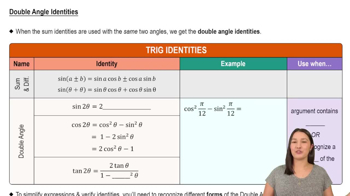
The half-angle identities are formulas that express trigonometric functions of half an angle in terms of the functions of the original angle. For cosine, the half-angle identity states that cos(θ/2) = ±√[(1 + cos θ)/2]. This identity is particularly useful for simplifying expressions like ±√[(1 + cos 20α)/2] by recognizing that it represents cos(10α).
The square root function returns the principal (non-negative) root of a number, while the ± symbol indicates that both the positive and negative roots are considered. In trigonometric simplifications, understanding how to handle square roots and the implications of the ± sign is crucial for accurately expressing the results, especially when dealing with angles and their trigonometric values.