Recognize that the expression \( \pm \sqrt{\frac{1 + \cos(\frac{x}{4})}{2}} \) is related to a trigonometric identity.
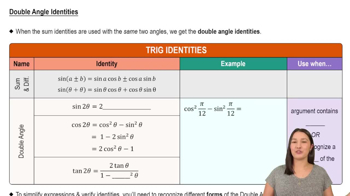
Recall the half-angle identity for cosine: \( \cos(\theta/2) = \pm \sqrt{\frac{1 + \cos(\theta)}{2}} \).
Identify that the expression \( \pm \sqrt{\frac{1 + \cos(\frac{x}{4})}{2}} \) matches the form of the half-angle identity.
Conclude that \( \pm \sqrt{\frac{1 + \cos(\frac{x}{4})}{2}} \) simplifies to \( \cos(\frac{x}{8}) \) or \( -\cos(\frac{x}{8}) \), depending on the quadrant of \( \frac{x}{8} \).
Determine the sign (positive or negative) based on the specific interval or quadrant where \( \frac{x}{8} \) lies.
Verified video answer for a similar problem:
This video solution was recommended by our tutors as helpful for the problem above
Play a video:
Was this helpful?
Key Concepts
Here are the essential concepts you must grasp in order to answer the question correctly.
Cosine Function
The cosine function, denoted as cos(x), is a fundamental trigonometric function that relates the angle of a right triangle to the ratio of the length of the adjacent side to the hypotenuse. It is periodic with a period of 2π and varies between -1 and 1. Understanding the properties of the cosine function is essential for simplifying expressions involving it.
The half-angle identities are trigonometric identities that express the sine and cosine of half an angle in terms of the cosine of the full angle. For example, cos(x/2) can be expressed as ±√[(1 + cos(x))/2]. These identities are crucial for simplifying expressions that involve angles divided by two, as seen in the given expression.
Square root properties involve the rules governing the manipulation of square roots in mathematical expressions. For instance, √(a/b) = √a/√b and √(a) * √(b) = √(ab). Understanding these properties is vital for simplifying expressions that include square roots, such as the one presented in the question.