Recognize that the expression inside the square root, \(\frac{1 + \cos 20\alpha}{2}\), matches the form of the cosine double-angle identity rearranged for cosine squared: \(\cos^2 \theta = \frac{1 + \cos 2\theta}{2}\).
Identify the angle \(\theta\) such that \(2\theta = 20\alpha\), which gives \(\theta = 10\alpha\).
Rewrite the expression inside the square root as \(\cos^2 10\alpha\) using the identity: \(\frac{1 + \cos 20\alpha}{2} = \cos^2 10\alpha\).
Take the square root of \(\cos^2 10\alpha\), which results in \(|\cos 10\alpha|\) because the square root of a square is the absolute value of the original expression.
Include the \(\pm\) sign given in the problem, so the simplified expression is \(\pm \cos 10\alpha\), noting that the absolute value and \(\pm\) together cover all possible signs.
Verified video answer for a similar problem:
This video solution was recommended by our tutors as helpful for the problem above
Play a video:
0 Comments
Key Concepts
Here are the essential concepts you must grasp in order to answer the question correctly.
Half-Angle Identity for Cosine
The half-angle identity expresses the cosine of an angle in terms of the cosine of half that angle. Specifically, cos²(θ) = (1 + cos 2θ)/2, which can be rearranged to find cos θ or sin θ using square roots. This identity is essential for simplifying expressions involving (1 + cos 2α)/2.
Square Root and ± Sign in Trigonometric Expressions
When taking the square root of a squared trigonometric function, the result includes a ± sign to account for both positive and negative roots. Determining the correct sign depends on the angle's quadrant or context, which is crucial for accurate simplification.
Simplifying trigonometric expressions involves applying identities and algebraic manipulation to rewrite expressions in simpler or more recognizable forms. Recognizing patterns like half-angle formulas helps reduce complex expressions to basic trigonometric functions.

 Verified step by step guidance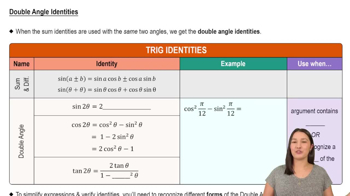
 05:06
05:06