Solve for exact solutions over the interval [0°, 360°). cos θ/2 = -1/2
Verified step by step guidance
1
Start by rewriting the equation \( \cos \frac{\theta}{2} = -\frac{1}{2} \) and recognize that you need to find all angles \( \frac{\theta}{2} \) whose cosine value is \( -\frac{1}{2} \).
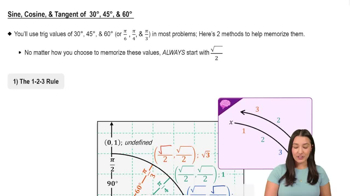
Recall the unit circle values where \( \cos x = -\frac{1}{2} \). These occur at angles \( x = 120^\circ \) and \( x = 240^\circ \) within one full rotation \( [0^\circ, 360^\circ) \).
Set \( \frac{\theta}{2} = 120^\circ + 360^\circ k \) and \( \frac{\theta}{2} = 240^\circ + 360^\circ k \), where \( k \) is any integer, to account for all possible solutions.
Multiply both sides of each equation by 2 to solve for \( \theta \): \( \theta = 240^\circ + 720^\circ k \) and \( \theta = 480^\circ + 720^\circ k \).
Finally, find all values of \( \theta \) within the interval \( [0^\circ, 360^\circ) \) by substituting integer values of \( k \) and selecting those that fall within the given range.
Verified video answer for a similar problem:
This video solution was recommended by our tutors as helpful for the problem above
Play a video:
0 Comments
Key Concepts
Here are the essential concepts you must grasp in order to answer the question correctly.
Solving Trigonometric Equations
Solving trigonometric equations involves finding all angle values that satisfy the given equation within a specified interval. This requires isolating the trigonometric function and determining the angles whose function values match the given number, considering the periodic nature of trigonometric functions.
The cosine function relates an angle to the x-coordinate on the unit circle. Knowing key cosine values, such as cos 60° = 1/2 and cos 120° = -1/2, helps identify angles that satisfy equations like cos(θ/2) = -1/2. Understanding cosine’s behavior over one full rotation (0° to 360°) is essential.
When solving trigonometric equations over a specific interval, it is important to consider the domain of the original variable. Here, θ is restricted to [0°, 360°), so after solving for θ/2, solutions must be adjusted and filtered to ensure θ falls within this range.