
Textbook Question
For each value of s, use a calculator to find sin s and cos s, and then use the results to decide in which quadrant an angle of s radians lies.
s = 65
739
views

 Verified step by step guidance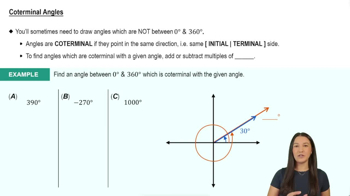
 04:46
04:46
 5:43
5:43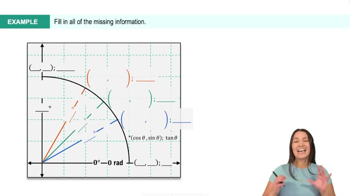 6:04
6:04For each value of s, use a calculator to find sin s and cos s, and then use the results to decide in which quadrant an angle of s radians lies.
s = 65
For each value of s, use a calculator to find sin s and cos s, and then use the results to decide in which quadrant an angle of s radians lies.
s = 51
Suppose an arc of length s lies on the unit circle x² + y² = 1, starting at the point (1, 0) and terminating at the point (x, y). (See Figure 12, repeated below.) Use a calculator to find the approximate coordinates for (x, y) to four decimal places.
s = ―7.4
<IMAGE>
Through how many radians does the minute hand on a clock rotate in (a) 12 hr and (b) 3 hr?
Find each exact function value. See Example 3.
sin (-7π/ 6)
Give an expression that generates all angles coterminal with an angle of π/2 radians. Let n represent any integer.