Graph each function over a two-period interval. y = 1 + tan x
Verified step by step guidance
1
Step 1: Understand the basic properties of the tangent function, \( \tan x \), which has a period of \( \pi \). This means the function repeats every \( \pi \) units.
Step 2: Recognize that the function \( y = 1 + \tan x \) is a vertical shift of the basic tangent function by 1 unit upwards.
Step 3: Determine the period of the function \( y = 1 + \tan x \). Since the period of \( \tan x \) is \( \pi \), the period of \( y = 1 + \tan x \) remains \( \pi \).
Step 4: Identify the two-period interval for graphing. Since the period is \( \pi \), a two-period interval would be from \( 0 \) to \( 2\pi \).
Step 5: Plot the function over the interval \( 0 \) to \( 2\pi \), taking into account the vertical shift. The graph will have vertical asymptotes at \( x = \frac{\pi}{2} + n\pi \) for integers \( n \), and the function will pass through points like \( (0, 1) \), \( (\pi, 1) \), etc.
Verified video answer for a similar problem:
This video solution was recommended by our tutors as helpful for the problem above
Play a video:
Was this helpful?
Key Concepts
Here are the essential concepts you must grasp in order to answer the question correctly.
Tangent Function
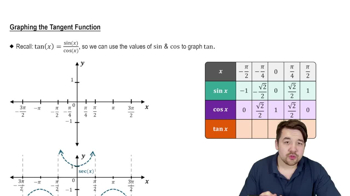
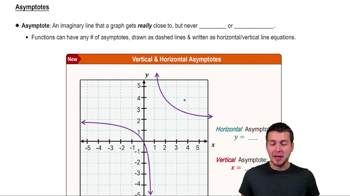
The tangent function, denoted as tan(x), is a periodic function defined as the ratio of the sine and cosine functions: tan(x) = sin(x)/cos(x). It has a period of π, meaning it repeats its values every π radians. The function has vertical asymptotes where the cosine function equals zero, specifically at x = (π/2) + nπ, where n is any integer.
Graphing periodic functions involves plotting the function over a specified interval to visualize its repeating nature. For the tangent function, one must consider its asymptotes and the points where it crosses the x-axis. In this case, the function y = 1 + tan(x) shifts the entire graph of tan(x) upward by 1 unit, affecting its intercepts and vertical asymptotes.
Transformations of functions involve shifting, stretching, or reflecting the graph of a function. In the case of y = 1 + tan(x), the '+1' indicates a vertical shift upwards by one unit. Understanding transformations is crucial for accurately graphing functions, as they alter the position and shape of the original graph while maintaining its overall periodicity.