Ch. 5 - Trigonometric Identities
Lial - Trigonometry 12th Edition
Lial12th EditionTrigonometryISBN: 9780136552161Not the one you use?Change textbook
Chapter 6, Problem 52

Verify that each equation is an identity.
(sin 2x)/(sin x) = 2/sec x

Verified step by step guidance
1
Start by writing down the given equation to verify: \(\frac{\sin 2x}{\sin x} = \frac{2}{\sec x}\).
Recall the double-angle identity for sine: \(\sin 2x = 2 \sin x \cos x\). Substitute this into the left side of the equation to get \(\frac{2 \sin x \cos x}{\sin x}\).
Simplify the left side by canceling \(\sin x\) in the numerator and denominator, resulting in \(2 \cos x\).
Rewrite the right side by expressing \(\sec x\) in terms of cosine: \(\sec x = \frac{1}{\cos x}\), so \(\frac{2}{\sec x} = 2 \cos x\).
Compare both sides: the left side simplifies to \(2 \cos x\) and the right side is also \(2 \cos x\), confirming the identity.

Verified video answer for a similar problem:

This video solution was recommended by our tutors as helpful for the problem above.
Was this helpful?

Key Concepts

Here are the essential concepts you must grasp in order to answer the question correctly.

Trigonometric Identities

Trigonometric identities are equations involving trigonometric functions that hold true for all values within their domains. Verifying an identity means showing both sides simplify to the same expression using known formulas, such as Pythagorean identities or angle formulas.
Recommended video:
5:32
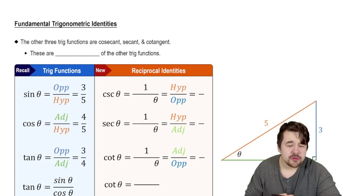
Fundamental Trigonometric Identities

Double-Angle Formulas

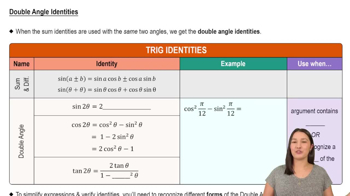
Double-angle formulas express trigonometric functions of twice an angle in terms of single angles. For example, sin(2x) = 2 sin x cos x, which is essential for rewriting and simplifying expressions involving sin 2x.
Recommended video:
05:06
Double Angle Identities

Reciprocal Trigonometric Functions

Reciprocal functions relate basic trig functions to their inverses, such as sec x = 1/cos x. Understanding these relationships helps convert expressions like 2/sec x into forms involving sine and cosine for easier comparison.
Recommended video:
6:04
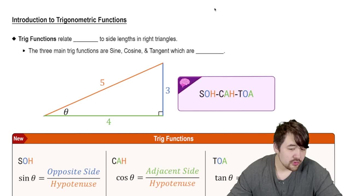
Introduction to Trigonometric Functions