Concept Check Match each angle in Column I with its reference angle in Column II. Choices may be used once, more than once, or not at all. See Example 1. I. II. 5. A. 45° 6. B. 60° 7. C. 82° 8. D. 30° 9. E. 38° 10. 480° F. 32°
Verified step by step guidance
1
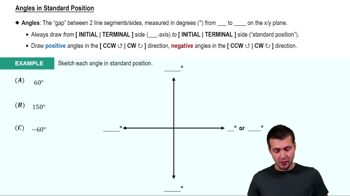
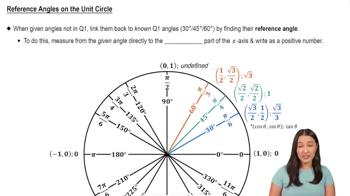
Understand that the reference angle of any given angle is the acute angle formed between the terminal side of the angle and the x-axis. It is always between 0° and 90°.
For angles greater than 360°, first find the equivalent angle between 0° and 360° by subtracting multiples of 360°. For example, for 480°, calculate \$480° - 360° = 120°$.
Determine the quadrant of the angle after reducing it to between 0° and 360°. For example, 120° lies in the second quadrant.
Match each angle from Column I with the corresponding reference angle from Column II by applying the above steps to each angle.
Verified video answer for a similar problem:
This video solution was recommended by our tutors as helpful for the problem above
Video duration:
1m
Play a video:
0 Comments
Key Concepts
Here are the essential concepts you must grasp in order to answer the question correctly.
Reference Angle
A reference angle is the acute angle formed between the terminal side of a given angle and the x-axis. It is always between 0° and 90°, and helps simplify trigonometric calculations by relating any angle to a corresponding acute angle.
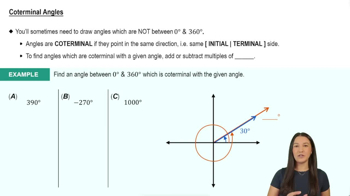
Coterminal angles differ by full rotations of 360°. For example, 480° is coterminal with 480° - 360° = 120°. Identifying coterminal angles helps reduce large angles to an equivalent angle within 0° to 360° for easier reference angle determination.
The quadrant in which an angle lies affects how its reference angle is calculated. Angles in Quadrant I have reference angles equal to themselves, while in other quadrants, the reference angle is found by subtracting the angle from 180°, 270°, or 360°, depending on the quadrant.

 1:56 minutes
 Verified step by step guidance
 5:31
5:31