Ch. 4 - Graphs of the Circular Functions
Lial - Trigonometry 12th Edition
Lial12th EditionTrigonometryISBN: 9780136552161Not the one you use?Change textbook
Chapter 5, Problem 4.38

Consider the function g(x) = -2 csc (4x + π). What is the domain of g? What is its range?

Verified step by step guidance
1
Identify the function: \( g(x) = -2 \csc(4x + \pi) \). The cosecant function, \( \csc(\theta) \), is the reciprocal of the sine function, \( \sin(\theta) \).
Determine the domain: The sine function is undefined where it equals zero, so \( \csc(\theta) \) is undefined where \( \sin(\theta) = 0 \). Solve \( \sin(4x + \pi) = 0 \) to find the values of \( x \) that make \( g(x) \) undefined.
Solve for \( x \) in \( \sin(4x + \pi) = 0 \): The sine function is zero at integer multiples of \( \pi \), so set \( 4x + \pi = n\pi \), where \( n \) is an integer. Solve for \( x \) to find the excluded values.
Determine the range: The range of \( \csc(\theta) \) is \(( -\infty, -1 ] \cup [ 1, \infty )\). Since \( g(x) = -2 \csc(4x + \pi) \), multiply the range of \( \csc(\theta) \) by \(-2\) to find the range of \( g(x) \).
Conclude the domain and range: The domain excludes the values of \( x \) found in step 3, and the range is the result from step 4.

Verified video answer for a similar problem:

This video solution was recommended by our tutors as helpful for the problem above.
Video duration:
9m
Was this helpful?

Key Concepts

Here are the essential concepts you must grasp in order to answer the question correctly.

Cosecant Function

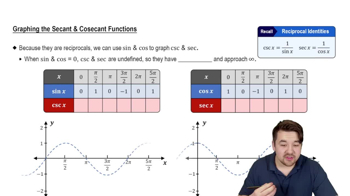
The cosecant function, denoted as csc(x), is the reciprocal of the sine function, defined as csc(x) = 1/sin(x). It is important to note that the cosecant function is undefined wherever the sine function is zero, which occurs at integer multiples of π. Understanding the behavior of the cosecant function is crucial for determining the domain and range of functions that involve it.
Recommended video:
6:22
Graphs of Secant and Cosecant Functions

Domain of a Function

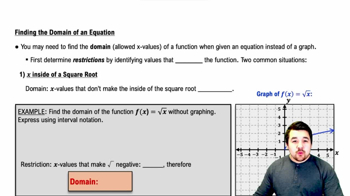
The domain of a function refers to the set of all possible input values (x-values) for which the function is defined. For the function g(x) = -2 csc(4x + π), the domain is restricted by the values that make the sine function zero. Identifying these values allows us to determine where the function g(x) is undefined, thus establishing its domain.
Recommended video:
3:43
Finding the Domain of an Equation

Range of a Function

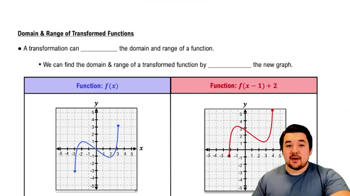
The range of a function is the set of all possible output values (y-values) that the function can produce. For the cosecant function, the range is limited to values outside the interval (-1, 1) because csc(x) approaches infinity as sin(x) approaches zero. For g(x) = -2 csc(4x + π), the range can be derived from the properties of the cosecant function, taking into account the vertical stretch and reflection caused by the coefficient -2.
Recommended video:
4:22
Domain and Range of Function Transformations