Refer to vectors a through h below. Make a copy or a sketch of each vector, and then draw a sketch to represent each of the following. For example, find a + e by placing a and e so that their initial points coincide. Then use the parallelogram rule to find the resultant, as shown in the figure on the right.
<IMAGE>
c + d
Verified step by step guidance
1
Identify vectors \( \mathbf{c} \) and \( \mathbf{d} \) from the given image or description.
Sketch vector \( \mathbf{c} \) on a graph or coordinate plane, starting from an initial point.
From the same initial point, sketch vector \( \mathbf{d} \) to ensure both vectors have their initial points coinciding.
Use the parallelogram rule: complete the parallelogram by drawing lines parallel to \( \mathbf{c} \) and \( \mathbf{d} \) from the tips of each vector.
The diagonal of the parallelogram starting from the initial point represents the resultant vector \( \mathbf{c} + \mathbf{d} \).
Was this helpful?
Key Concepts
Here are the essential concepts you must grasp in order to answer the question correctly.
Vector Addition
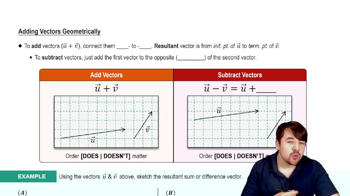
Vector addition involves combining two or more vectors to determine a resultant vector. This can be done graphically by placing the tail of one vector at the head of another, or by using the parallelogram rule, where two vectors are represented as adjacent sides of a parallelogram, and the diagonal represents the resultant.
The parallelogram rule is a method for finding the resultant of two vectors. By drawing the two vectors as adjacent sides of a parallelogram, the diagonal from the common initial point to the opposite corner represents the resultant vector in both magnitude and direction.
Sketching vectors accurately is crucial for visualizing vector addition and understanding their relationships. Each vector is represented by an arrow, where the length indicates magnitude and the direction of the arrow indicates the vector's direction. Properly sketching vectors helps in applying the parallelogram rule effectively.