In Exercises 7–16, determine the amplitude and period of each function. Then graph one period of the function.y = -sin 2/3 x
Verified step by step guidance
1
Identify the standard form of the sine function, which is \( y = a \sin(bx + c) + d \). In this case, the function is \( y = -\sin\left(\frac{2}{3}x\right) \).
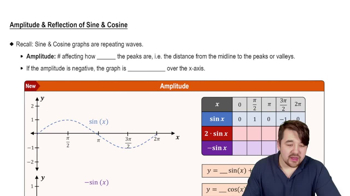
Determine the amplitude of the function. The amplitude is the absolute value of the coefficient \( a \). Here, \( a = -1 \), so the amplitude is \( |a| = 1 \).
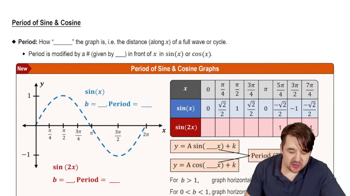
Find the period of the function. The period of a sine function is given by \( \frac{2\pi}{|b|} \), where \( b \) is the coefficient of \( x \). In this function, \( b = \frac{2}{3} \), so the period is \( \frac{2\pi}{\frac{2}{3}} = 3\pi \).
Graph one period of the function. Start at \( x = 0 \) and use the period \( 3\pi \) to determine the endpoint of one cycle. The key points for the sine function are at \( 0, \frac{3\pi}{4}, \frac{3\pi}{2}, \frac{9\pi}{4}, \) and \( 3\pi \).
Plot the points for one period: \( (0, 0) \), \( (\frac{3\pi}{4}, -1) \), \( (\frac{3\pi}{2}, 0) \), \( (\frac{9\pi}{4}, 1) \), and \( (3\pi, 0) \). Connect these points with a smooth curve to complete the graph of one period of the function.
Verified video answer for a similar problem:
This video solution was recommended by our tutors as helpful for the problem above
Video duration:
7m
Play a video:
Was this helpful?
Key Concepts
Here are the essential concepts you must grasp in order to answer the question correctly.
Amplitude
Amplitude refers to the maximum distance a wave reaches from its central axis or equilibrium position. In the context of sine functions, it is determined by the coefficient in front of the sine term. For the function y = -sin(2/3 x), the amplitude is 1, as the coefficient of sin is -1, indicating the wave oscillates between 1 and -1.
The period of a trigonometric function is the length of one complete cycle of the wave. For sine functions, the period can be calculated using the formula P = 2π / |b|, where b is the coefficient of x. In the function y = -sin(2/3 x), b is 2/3, leading to a period of P = 2π / (2/3) = 3π.
Graphing trigonometric functions involves plotting the function over a specified interval to visualize its behavior. For y = -sin(2/3 x), one period can be graphed from 0 to 3π, showing the wave starting at 0, reaching its maximum at π/2, crossing the axis at π, reaching its minimum at 3π/2, and returning to 0 at 3π. The negative sign indicates the wave is reflected across the x-axis.