Determine whether each statement is possible or impossible. c. cos θ = 5
Verified step by step guidance
1
Recall the range of the cosine function: for any angle \( \theta \), \( \cos \theta \) must satisfy \( -1 \leq \cos \theta \leq 1 \).
Analyze the given statement \( \cos \theta = 5 \). Since 5 is greater than 1, it lies outside the possible range of cosine values.
Conclude that \( \cos \theta = 5 \) is impossible because cosine values cannot exceed 1 or be less than -1.
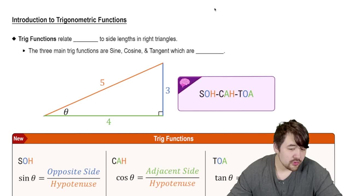
Understand that cosine represents the ratio of the adjacent side to the hypotenuse in a right triangle, and since the hypotenuse is always the longest side, this ratio cannot be greater than 1.
Therefore, any value of cosine outside the interval \( [-1, 1] \) is not achievable for any real angle \( \theta \).
Verified video answer for a similar problem:
This video solution was recommended by our tutors as helpful for the problem above
Play a video:
0 Comments
Key Concepts
Here are the essential concepts you must grasp in order to answer the question correctly.
Range of the Cosine Function
The cosine function outputs values only within the range of -1 to 1 for all real angles θ. This means any value outside this interval, such as 5, cannot be the cosine of any angle, making such statements impossible.
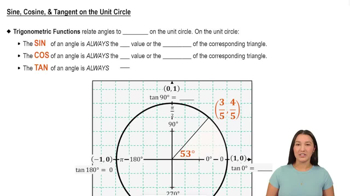
Cosine of an angle θ corresponds to the x-coordinate of the point on the unit circle at that angle. Since the unit circle has radius 1, the x-coordinate (cos θ) must lie between -1 and 1, reinforcing the range limitation.
Trigonometric functions have inherent properties and constraints based on their geometric and analytic definitions. Recognizing these constraints helps determine the possibility or impossibility of given trigonometric values.