Ch. 2 - Acute Angles and Right Triangles
Lial - Trigonometry 12th Edition
Lial12th EditionTrigonometryISBN: 9780136552161Not the one you use?Change textbook
Chapter 3, Problem 32

Solve each right triangle. In each case, C = 90°. If angle information is given in degrees and minutes, give answers in the same way. If angle information is given in decimal degrees, do likewise in answers. When two sides are given, give angles in degrees and minutes. See Examples 1 and 2. b = 32 ft, c = 51 ft

Verified step by step guidance
1
Identify the given elements of the right triangle: side b = 32 ft (one leg), side c = 51 ft (the hypotenuse), and angle C = 90° (right angle).
Use the Pythagorean theorem to find the missing side a: write the equation as \(a^2 + b^2 = c^2\), then solve for \(a\) by calculating \(a = \sqrt{c^2 - b^2}\).
Calculate angle A using the sine function, since you know side b (opposite to angle A) and hypotenuse c: use \(\sin A = \frac{b}{c}\), then find \(A = \arcsin\left(\frac{b}{c}\right)\).
Convert the angle A from decimal degrees to degrees and minutes if necessary, by separating the integer degree part and converting the decimal part to minutes (1 degree = 60 minutes).
Find angle B by using the fact that the sum of angles in a triangle is 180°, and since angle C is 90°, calculate \(B = 90° - A\); convert angle B to degrees and minutes if needed.

Verified video answer for a similar problem:

This video solution was recommended by our tutors as helpful for the problem above.
Video duration:
3m
Was this helpful?

Key Concepts

Here are the essential concepts you must grasp in order to answer the question correctly.

Right Triangle Properties

A right triangle has one angle exactly 90°, which simplifies calculations since the other two angles must sum to 90°. Knowing one side and the right angle allows use of trigonometric ratios to find unknown sides or angles.
Recommended video:
5:35
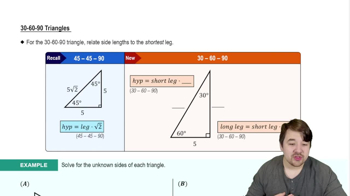
30-60-90 Triangles

Pythagorean Theorem

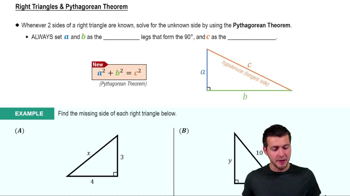
This theorem states that in a right triangle, the square of the hypotenuse (side opposite the right angle) equals the sum of the squares of the other two sides. It is essential for finding the missing side when two sides are known.
Recommended video:
5:19
Solving Right Triangles with the Pythagorean Theorem

Trigonometric Ratios and Angle Conversion

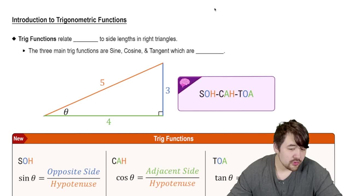
Sine, cosine, and tangent relate angles to side lengths in right triangles. Calculated angles may need conversion between decimal degrees and degrees-minutes format, requiring understanding of how to convert fractional degrees into minutes for precise answers.
Recommended video:
6:04
Introduction to Trigonometric Functions