Concept Check Refer to the discussion of accuracy and significant digits in this section to answer the following. Mt. Everest When Mt. Everest was first surveyed, the surveyors obtained a height of 29,000 ft to the nearest foot. State the range represented by this number. (The surveyors thought no one would believe a measurement of 29,000 ft, so they reported it as 29,002.) (Data from Dunham, W., The Mathematical Universe, John Wiley and Sons.)
Table of contents
- 0. Review of College Algebra4h 45m
- 1. Measuring Angles40m
- 2. Trigonometric Functions on Right Triangles2h 5m
- 3. Unit Circle1h 19m
- 4. Graphing Trigonometric Functions1h 19m
- 5. Inverse Trigonometric Functions and Basic Trigonometric Equations1h 41m
- 6. Trigonometric Identities and More Equations2h 34m
- 7. Non-Right Triangles1h 38m
- 8. Vectors2h 25m
- 9. Polar Equations2h 5m
- 10. Parametric Equations1h 6m
- 11. Graphing Complex Numbers1h 7m
2. Trigonometric Functions on Right Triangles
Solving Right Triangles
Problem 19
Textbook Question
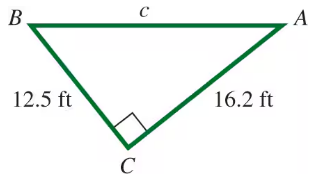
Solve each right triangle. When two sides are given, give angles in degrees and minutes.

Verified step by step guidance1
Identify the two given sides of the right triangle. Label the sides as opposite (O), adjacent (A), or hypotenuse (H) relative to the angle you want to find.
Use the Pythagorean theorem \(H^2 = O^2 + A^2\) to find the missing side if it is not given. Rearrange the formula to solve for the unknown side.
Choose the appropriate trigonometric ratio to find the unknown angle: sine \(\sin \theta = \frac{O}{H}\), cosine \(\cos \theta = \frac{A}{H}\), or tangent \(\tan \theta = \frac{O}{A}\), depending on the sides you know.
Calculate the angle \(\theta\) by taking the inverse trigonometric function: \(\theta = \sin^{-1}(\frac{O}{H})\), \(\theta = \cos^{-1}(\frac{A}{H})\), or \(\theta = \tan^{-1}(\frac{O}{A})\).
Convert the decimal degree result into degrees and minutes by separating the integer part as degrees and multiplying the decimal part by 60 to get minutes.
Verified video answer for a similar problem:This video solution was recommended by our tutors as helpful for the problem above
Play a video:
0 Comments
Key Concepts
Here are the essential concepts you must grasp in order to answer the question correctly.
Pythagorean Theorem
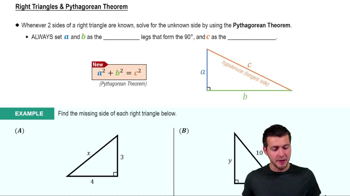
The Pythagorean theorem relates the lengths of the sides in a right triangle: the square of the hypotenuse equals the sum of the squares of the other two sides. It is essential for finding the missing side when two sides are known.
Recommended video:
Solving Right Triangles with the Pythagorean Theorem
Trigonometric Ratios (Sine, Cosine, Tangent)
Sine, cosine, and tangent ratios relate the angles of a right triangle to the ratios of its sides. These ratios allow calculation of unknown angles or sides when two sides are given, using inverse trigonometric functions to find angles.
Recommended video:
Sine, Cosine, & Tangent of 30°, 45°, & 60°
Conversion of Decimal Degrees to Degrees and Minutes
Angles are often expressed in degrees and minutes, where one degree equals 60 minutes. After calculating an angle in decimal degrees, converting the fractional part into minutes provides a more precise and conventional angle measurement.
Recommended video:
Converting between Degrees & Radians
Related Videos
Related Practice
Textbook Question
314
views