Identify the given elements in triangle ABC, such as known sides and angles. Typically, a triangle problem provides either two sides and an included angle (SAS), two angles and a side (AAS or ASA), or three sides (SSS). Determine which case applies here.
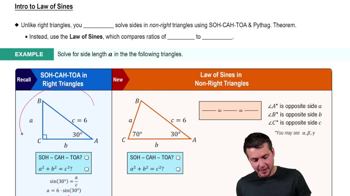
Use the Law of Sines or Law of Cosines depending on the known elements. For example, if you have two angles and one side, use the Law of Sines: \(\frac{a}{\sin\alpha} = \frac{b}{\sin\beta} = \frac{c}{\sin\gamma}\), where \(a\), \(b\), \(c\) are sides opposite angles \(\alpha\), \(\beta\), \(\gamma\) respectively.
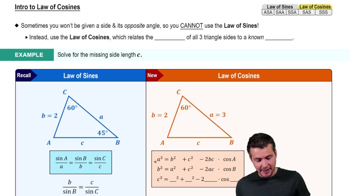
If you have two sides and the included angle, apply the Law of Cosines to find the third side: \(c^2 = a^2 + b^2 - 2ab \cos\gamma\). Then use the Law of Sines to find the remaining angles.
Once you find the missing sides or angles, use the fact that the sum of angles in a triangle is \(180^\circ\) to find any remaining angles: \(\alpha + \beta + \gamma = 180^\circ\).
Check your answers for consistency, ensuring all sides and angles satisfy the triangle properties and the laws used. This completes the solution of triangle ABC.
Verified video answer for a similar problem:
This video solution was recommended by our tutors as helpful for the problem above
Play a video:
0 Comments
Key Concepts
Here are the essential concepts you must grasp in order to answer the question correctly.
Triangle Classification and Properties
Understanding the types of triangles (right, acute, obtuse) and their properties is essential. This helps in determining which trigonometric rules or formulas apply, such as the Pythagorean theorem for right triangles or the Law of Sines and Cosines for non-right triangles.
The Law of Sines relates the ratios of the lengths of sides of a triangle to the sines of their opposite angles. It is useful for solving triangles when given two angles and one side or two sides and a non-included angle, allowing calculation of unknown sides or angles.
The Law of Cosines generalizes the Pythagorean theorem for any triangle, relating the lengths of sides to the cosine of an included angle. It is particularly helpful when two sides and the included angle or all three sides are known, enabling the determination of unknown sides or angles.

 Verified step by step guidance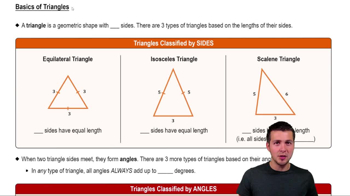
 4:42
4:42