Write each function value in terms of the cofunction of a complementary angle. sin 142° 14'
Verified step by step guidance
1
Convert the angle from degrees and minutes to a decimal degree format. To do this, divide the minutes by 60 and add the result to the degrees. For example, 14 minutes is 14/60 degrees.
Calculate the complementary angle by subtracting the given angle from 90°. The complementary angle of an angle \( \theta \) is \( 90° - \theta \).
Use the cofunction identity for sine, which states that \( \sin(\theta) = \cos(90° - \theta) \).
Substitute the complementary angle calculated in step 2 into the cofunction identity to express \( \sin(142° 14') \) in terms of cosine.
The expression is now in terms of the cofunction of the complementary angle.
Verified video answer for a similar problem:
This video solution was recommended by our tutors as helpful for the problem above
Play a video:
0 Comments
Key Concepts
Here are the essential concepts you must grasp in order to answer the question correctly.
Cofunction Identities
Cofunction identities in trigonometry state that the sine of an angle is equal to the cosine of its complementary angle. Specifically, for any angle θ, sin(θ) = cos(90° - θ). This relationship is crucial for rewriting trigonometric functions in terms of their cofunctions, especially when dealing with angles that exceed 90 degrees.
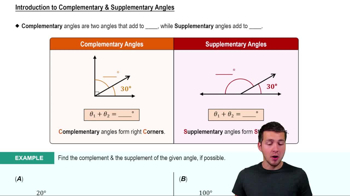
Complementary angles are two angles whose measures add up to 90 degrees. In the context of trigonometric functions, if you have an angle θ, its complement is given by 90° - θ. Understanding complementary angles is essential for applying cofunction identities effectively, as it allows for the transformation of functions into more manageable forms.
Angle conversion involves changing the representation of an angle from degrees to a more usable form, such as radians, or breaking it down into smaller components. In this case, converting 142° 14' into a more manageable angle helps in applying the cofunction identities. This process is important for accurately calculating and expressing trigonometric values.

 Verified step by step guidance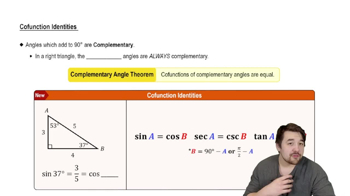
 6:30
6:30