Write each function value in terms of the cofunction of a complementary angle. cot (9π/10)
Verified step by step guidance
1
Recall the cofunction identity for cotangent: \( \cot(\theta) = \tan\left(\frac{\pi}{2} - \theta\right) \). This means the cotangent of an angle can be expressed as the tangent of its complementary angle.
Identify the given angle: \( \theta = \frac{9\pi}{10} \). We want to express \( \cot\left(\frac{9\pi}{10}\right) \) in terms of a tangent function of a complementary angle.
Calculate the complementary angle to \( \frac{9\pi}{10} \) by subtracting it from \( \frac{\pi}{2} \): \(\n\)\( \frac{\pi}{2} - \frac{9\pi}{10} \).
Simplify the expression for the complementary angle by finding a common denominator and performing the subtraction.
Rewrite \( \cot\left(\frac{9\pi}{10}\right) \) as \( \tan \) of the complementary angle found in the previous step, using the identity from step 1.
Verified video answer for a similar problem:
This video solution was recommended by our tutors as helpful for the problem above
Play a video:
0 Comments
Key Concepts
Here are the essential concepts you must grasp in order to answer the question correctly.
Cofunction Identities
Cofunction identities relate trigonometric functions of complementary angles, where the sum of the angles is π/2 (90°). For example, sine and cosine are cofunctions: sin(θ) = cos(π/2 - θ). These identities help express one trig function in terms of another evaluated at the complementary angle.
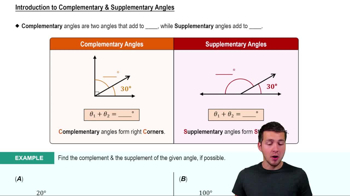
Complementary angles are two angles whose measures add up to π/2 radians (90 degrees). Understanding this concept is essential because cofunction identities depend on the relationship between an angle and its complement, allowing transformation of function values accordingly.
The cotangent function, cot(θ), is the reciprocal of tangent and is related to the tangent function by cofunction identities. Specifically, cot(θ) = tan(π/2 - θ), meaning cotangent of an angle can be expressed as the tangent of its complementary angle, which is key to rewriting cot(9π/10) in terms of a cofunction.

 Verified step by step guidance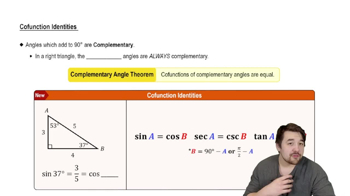
 6:30
6:30