A company wants to determine whether the average monthly sales differ among three different regions: North, South, and West. The company collects monthly sales data (in thousands of dollars) from four randomly selected stores in each region over the same month. Calculate the F-statistic given the Mean Square due to Treatments: MST = (variance between groups) and the Mean Square due to Error: MSE = (variance within groups).
Table of contents
- 1. Introduction to Statistics53m
- 2. Describing Data with Tables and Graphs2h 1m
- 3. Describing Data Numerically2h 8m
- 4. Probability2h 26m
- 5. Binomial Distribution & Discrete Random Variables3h 28m
- 6. Normal Distribution & Continuous Random Variables2h 21m
- 7. Sampling Distributions & Confidence Intervals: Mean3h 37m
- Sampling Distribution of the Sample Mean and Central Limit Theorem19m
- Distribution of Sample Mean - Excel23m
- Introduction to Confidence Intervals22m
- Confidence Intervals for Population Mean1h 26m
- Determining the Minimum Sample Size Required12m
- Finding Probabilities and T Critical Values - Excel28m
- Confidence Intervals for Population Means - Excel25m
- 8. Sampling Distributions & Confidence Intervals: Proportion1h 33m
- 9. Hypothesis Testing for One Sample3h 32m
- 10. Hypothesis Testing for Two Samples4h 49m
- Two Proportions1h 12m
- Two Proportions Hypothesis Test - Excel28m
- Two Means - Unknown, Unequal Variance1h 2m
- Two Means - Unknown Variances Hypothesis Test - Excel12m
- Two Means - Unknown, Equal Variance15m
- Two Means - Unknown, Equal Variances Hypothesis Test - Excel9m
- Two Means - Known Variance12m
- Two Means - Sigma Known Hypothesis Test - Excel21m
- Two Means - Matched Pairs (Dependent Samples)42m
- Matched Pairs Hypothesis Test - Excel12m
- 11. Correlation1h 24m
- 12. Regression1h 59m
- 13. Chi-Square Tests & Goodness of Fit2h 31m
- 14. ANOVA2h 1m
14. ANOVA
Introduction to ANOVA
Struggling with Statistics for Business?
Join thousands of students who trust us to help them ace their exams!Watch the first videoMultiple Choice
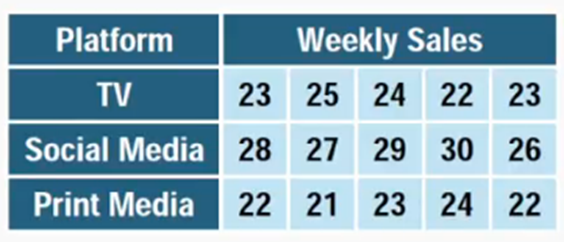
A marketing manager wants to evaluate whether three different advertising platforms-TV, social media, and print media-lead to different average sales performance across regional stores. She runs a 4-week advertising campaign, assigning one platform to a group of 5 stores each (15 stores total). After the campaign, she collects the average weekly sales (in \$1,000s) for each store during the campaign period. She wants to determine whether there is a statistically significant difference in mean sales among the three advertising platforms. State the null & alternative hypotheses for a one-way ANOVA test.

A
: All means are the same
: At least one advertising platform leads to a significant difference in average sales.
B
H0: At least one advertising platform leads to a significant difference in average sales.
Ha: All means are the same.
C
H0: There is a significant difference in the mean sales among the three advertising platforms.
Ha: There is no significant difference in the mean sales among the three advertising platforms.
D
H0: The mean sales are equal for TV advertising but differ for social media and print media platforms.
Ha: The mean sales differ for all three advertising platforms.
Verified step by step guidance1
Step 1: Define the null hypothesis (H₀) and the alternative hypothesis (Hₐ) for the one-way ANOVA test. H₀: All means are the same (no significant difference in average sales among the three advertising platforms). Hₐ: At least one advertising platform leads to a significant difference in average sales.
Step 2: Organize the data into groups based on the advertising platform. From the table, the weekly sales for TV are {23, 25, 24, 22, 23}, for Social Media are {28, 27, 29, 30, 26}, and for Print Media are {22, 21, 23, 24, 22}.
Step 3: Calculate the group means and the overall mean. The group means are the average weekly sales for each platform, and the overall mean is the average of all sales data combined.
Step 4: Compute the sum of squares between groups (SSB) and the sum of squares within groups (SSW). SSB measures the variation between the group means and the overall mean, while SSW measures the variation within each group.
Step 5: Use the ANOVA formula to calculate the F-statistic: F = (SSB / df_between) / (SSW / df_within), where df_between = number of groups - 1 and df_within = total number of observations - number of groups. Compare the F-statistic to the critical value from the F-distribution table at the chosen significance level (e.g., α = 0.05) to determine whether to reject H₀.
Watch next
Master Introduction to ANOVA with a bite sized video explanation from Patrick
Start learningRelated Videos
Related Practice
Multiple Choice
Introduction to ANOVA practice set

