Find the exact value of each real number y if it exists. Do not use a calculator. y = arctan 0
Verified step by step guidance
1
Understand that \( y = \arctan(0) \) means we are looking for an angle \( y \) whose tangent is 0.
Recall that the tangent of an angle in a right triangle is the ratio of the opposite side to the adjacent side.
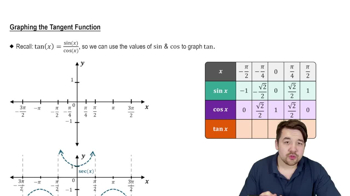
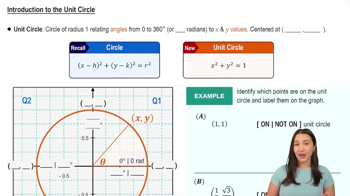
Consider the unit circle: the tangent of an angle \( \theta \) is \( \frac{\sin(\theta)}{\cos(\theta)} \).
For \( \tan(\theta) = 0 \), the sine of the angle must be 0, which occurs when \( \theta = 0 \) or \( \theta = \pi \) (and so on for multiples of \( \pi \)).
Since \( \arctan \) typically returns values in the range \(-\frac{\pi}{2} \leq y \leq \frac{\pi}{2}\), the exact value of \( y \) is \( 0 \).
Verified video answer for a similar problem:
This video solution was recommended by our tutors as helpful for the problem above
Play a video:
0 Comments
Key Concepts
Here are the essential concepts you must grasp in order to answer the question correctly.
Inverse Trigonometric Functions
Inverse trigonometric functions, such as arctan, are used to find angles when given a ratio of sides in a right triangle. For example, arctan(x) gives the angle whose tangent is x. Understanding these functions is crucial for solving equations involving angles and their corresponding trigonometric ratios.
The tangent function, defined as the ratio of the opposite side to the adjacent side in a right triangle, is periodic and can take any real number value. The arctan function specifically finds the angle whose tangent equals a given number, which is essential for determining angles from their tangent values.
The unit circle is a fundamental concept in trigonometry that helps visualize the relationships between angles and their corresponding sine, cosine, and tangent values. It provides a geometric interpretation of trigonometric functions, where the angle is measured from the positive x-axis, and the coordinates of points on the circle represent the cosine and sine of that angle.


 Verified step by step guidance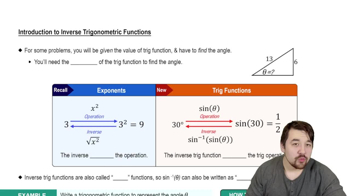
 4:28
4:28