Solve each equation for x, where x is restricted to the given interval. y = ―4 + 2 sin x , for x in [―π/2. π/2]
Verified step by step guidance
1
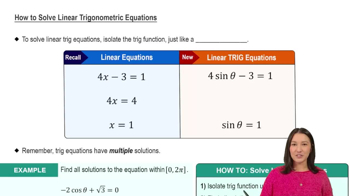
Start by isolating the sine function: add 4 to both sides of the equation to get y + 4 = 2 \sin x.
Divide both sides by 2 to solve for \sin x: \sin x = \frac{y + 4}{2}.
Determine the range of \sin x, which is between -1 and 1. Ensure that \frac{y + 4}{2} falls within this range.
Use the inverse sine function to solve for x: x = \arcsin\left(\frac{y + 4}{2}\right).
Check that the solution for x is within the interval \left[-\frac{\pi}{2}, \frac{\pi}{2}\right].
Verified video answer for a similar problem:
This video solution was recommended by our tutors as helpful for the problem above
Play a video:
Was this helpful?
Key Concepts
Here are the essential concepts you must grasp in order to answer the question correctly.
Sine Function
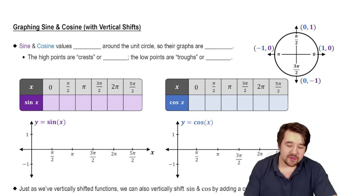
The sine function, denoted as sin(x), is a fundamental trigonometric function that relates the angle x (measured in radians) to the ratio of the length of the opposite side to the hypotenuse in a right triangle. It oscillates between -1 and 1, making it crucial for solving equations involving periodic behavior, such as the one presented in the question.
Transformations of functions involve shifting, stretching, or compressing the graph of a function. In the equation y = -4 + 2 sin(x), the term -4 represents a vertical shift downward by 4 units, while the coefficient 2 indicates a vertical stretch. Understanding these transformations is essential for accurately graphing the function and finding its solutions within the specified interval.
Interval notation is a mathematical notation used to represent a range of values. In this case, the interval [-π/2, π/2] specifies the domain of x for which we need to solve the equation. Recognizing the significance of this interval is important, as it restricts the possible solutions to those that fall within this range, affecting the final answer.