In Exercises 27–38, use a calculator to find the value of each expression rounded to two decimal places. sin⁻¹ 0.3
Ch. 2 - Graphs of the Trigonometric Functions; Inverse Trigonometric Functions

All textbooks
Blitzer 3rd Edition
Ch. 2 - Graphs of the Trigonometric Functions; Inverse Trigonometric Functions
Problem 28
Blitzer 3rd Edition
Ch. 2 - Graphs of the Trigonometric Functions; Inverse Trigonometric Functions
Problem 28Chapter 2, Problem 28
In Exercises 21–28, an object moves in simple harmonic motion described by the given equation, where t is measured in seconds and d in inches. In each exercise, find the following: a. the maximum displacement b. the frequency c. the time required for one cycle. d = −4 sin 3π/2 t
Verified step by step guidance1
Identify the given equation of motion: \(d = -4 \sin \left( \frac{3\pi}{2} t \right)\). Here, \(d\) represents displacement in inches, and \(t\) is time in seconds.
Determine the maximum displacement by finding the amplitude of the sine function. The amplitude is the absolute value of the coefficient in front of the sine, which is \(|-4|\).
Find the angular frequency \(\omega\) from the argument of the sine function. The argument is \(\frac{3\pi}{2} t\), so \(\omega = \frac{3\pi}{2}\) radians per second.
Calculate the frequency \(f\) using the relationship between angular frequency and frequency: \(f = \frac{\omega}{2\pi}\). Substitute \(\omega = \frac{3\pi}{2}\) to express \(f\) in hertz (cycles per second).
Find the time period \(T\), which is the time required for one complete cycle, using the formula \(T = \frac{1}{f}\). This gives the duration of one full oscillation.

Verified video answer for a similar problem:
This video solution was recommended by our tutors as helpful for the problem above.
Video duration:
4mWas this helpful?
Key Concepts
Here are the essential concepts you must grasp in order to answer the question correctly.
Simple Harmonic Motion (SHM)
Simple Harmonic Motion describes oscillatory motion where the displacement varies sinusoidally with time. The general form is d(t) = A sin(ωt) or d(t) = A cos(ωt), where A is the amplitude, ω is the angular frequency, and t is time. Understanding SHM helps interpret the given equation and extract motion characteristics.
Recommended video:
Products of Complex Numbers in Polar Form
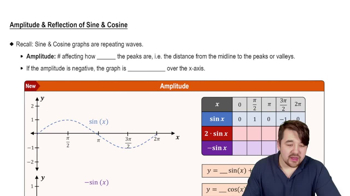
Amplitude and Maximum Displacement
Amplitude is the maximum distance an object moves from its equilibrium position in SHM. It corresponds to the coefficient before the sine or cosine function in the equation. In the given equation, the amplitude is 4 inches, indicating the maximum displacement the object reaches during its motion.
Recommended video:
Amplitude and Reflection of Sine and Cosine
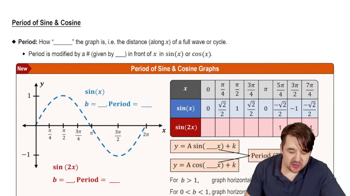
Frequency and Period of Oscillation
Frequency is the number of complete cycles per second, measured in hertz (Hz), and is related to angular frequency ω by f = ω/(2π). The period is the time for one full cycle, given by T = 1/f. These concepts allow calculation of how fast the object oscillates and the duration of each cycle from the equation's angular frequency.
Recommended video:
Period of Sine and Cosine Functions
Related Practice
Textbook Question
743
views
Textbook Question
In Exercises 29–44, graph two periods of the given cosecant or secant function. y = 3 csc x
1018
views
Textbook Question
In Exercises 17–30, determine the amplitude, period, and phase shift of each function. Then graph one period of the function. y = −2 sin(2πx + 4π)
561
views
Textbook Question
Use each graph to obtain the graph of the corresponding reciprocal function, cosecant or secant. Give the equation of the function for the graph that you obtain.
<IMAGE>
485
views
Textbook Question
In Exercises 25–28, use each graph to obtain the graph of the corresponding reciprocal function, cosecant or secant. Give the equation of the function for the graph that you obtain.
827
views
Textbook Question
In Exercises 29–36, find the length x to the nearest whole unit.
462
views