Find the exact value of each real number y if it exists. Do not use a calculator. y = sin⁻¹ (―1)
Verified step by step guidance
1
Understand that \( \sin^{-1} \) is the inverse sine function, also known as arcsin, which gives the angle whose sine is the given number.
Recognize that the problem asks for \( y = \sin^{-1}(-1) \), meaning we need to find the angle \( y \) such that \( \sin(y) = -1 \).
Recall that the range of the \( \sin^{-1} \) function is \([-\frac{\pi}{2}, \frac{\pi}{2}]\), which means \( y \) must be within this interval.
Identify that \( \sin(y) = -1 \) at \( y = -\frac{\pi}{2} \) within the specified range.
Conclude that the exact value of \( y \) is \(-\frac{\pi}{2}\).
Verified video answer for a similar problem:
This video solution was recommended by our tutors as helpful for the problem above
Play a video:
0 Comments
Key Concepts
Here are the essential concepts you must grasp in order to answer the question correctly.
Inverse Sine Function
The inverse sine function, denoted as sin⁻¹ or arcsin, is used to find the angle whose sine is a given number. Its range is restricted to [-π/2, π/2] to ensure that it is a function, meaning each input corresponds to exactly one output. This is crucial for determining the angle when given a sine value.
The sine function has a domain of all real numbers and a range of [-1, 1]. This means that the sine of any angle will always yield a value between -1 and 1. Understanding this range is essential when working with the inverse sine function, as it dictates the possible inputs for arcsin.
Exact values of trigonometric functions refer to specific angles where the sine, cosine, and tangent values can be expressed as simple fractions or radicals. For example, sin(−1) corresponds to the angle where the sine equals -1, which occurs at specific points on the unit circle, particularly at 3π/2 or -π/2.


 Verified step by step guidance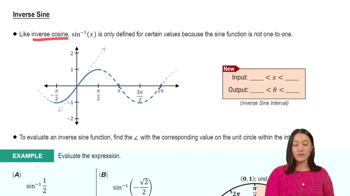
 4:03
4:03